

I am not sure when I realized that I no longer wanted to be the person I was when I worked for government.
Somewhere between leaving government after being assaulted at work in 2019 and starting doing Substack lives two weeks ago on the Community Social Recovery Model I built after years in emergency management, I changed. Noticing that made me realize that what had felt like failure over the last 5 years was actually me learning how to be different person.
A former colleague had an Einstein quote on her wall and I became aware I wanted to be “a person of value, not success; someone who added to the world, rather than taking from it” sometime during my government career.
It was a vague feel-good awareness. I remember thinking how neatly the sentiment fit within my own personal journey of becoming a safe adult, creating a healthy home for my kids.
What that pithy quote glosses over however, is the cost – social, emotional, psychological, and financial – of becoming a person of value in a culture that glorifies only financial success.
To learn to be different and evaluate self-worth using internal metrics rather than external comparison requires an unravelling of who you thought you are. Usually at the worst possible time of your life.
Identify the Issue
When I first decided I was going to have a business, I was angry at what I saw happening in the labour market: misogyny minimized by demanding empathy for the abuser, ageism becoming more widespread, child poverty was on the increase again.
The idea of working somewhere that was failing to do its actual function - governing to “provide a stronger province for current and future generations” - while still being paid for that work felt dirty. Especially since the services being cut were the same ones that my family and I had benefitted from when I was a child and then when I was a single mum.
I’d tried to ignore the fundamental changes in the civil service, but it was becoming increasingly hard. Could I look at my kids everyday knowing that when I went to work, I was actively writing briefing notes that undermined their future?
So, recognizing the workplace environment I lived in, and also having experienced discrimination and harassment, I developed an exit strategy. But the choice was forced upon me suddenly and I left, without the stability I would have liked.
Develop a Project Plan
Eventually the exit strategy became a business plan to do leadership training and provide consulting services (think gap analysis type stuff) to address the systemic failure I had “discovered.” Then I worked it with a coach, following rules that I was assured would eventually become clear.
To share my wisdom and (trauma-informed) solution with the world, I started to do all the things
Build an ICP (Ideal Client Profile)
Determine my social media platform and outreach strategy
What’s my tech stack?
Sign up to be on podcasts
Build a course and a keynote speech
Every time I sat down and did this work however, I had the same icky feeling in my stomach that I had in the final years working in government. This gnawing sense that what I was doing, while well-intentioned, was still not right.
So I doubled down, created more rules. I followed big thought leaders and small creators. I met with other people starting businesses or working in a similar space as me, trying to understand what I was missing. They made assertions with confidence in their slides so I went to presentations and listened to their frameworks, their guidance, their proposed solutions.
Everyone seemed to have a new list of steps for people to follow to achieve someone’s intended objectives, but more and more I wasn’t sure whose intended objectives any of us were achieving.
The Run-In
At one event, the presenter was discussing her leadership model. A critical component was “staff capacity” but it was being used in a couple of different ways. At times, it seemed to be referring to the team’s skillset, at others it referred to an individual’s willingness to take on the task, regardless of skill.
I asked for clarification on the definition of “capacity” for this particular framework. The presenter had no clear definition. The audience began discussing various definitions; all of which could have been correct, none of which were consistent. There was no clear conclusion on what capacity meant in this model.
As the presentation continued, there was another odd statement that I scrunched my face up as I pondered it, particularly since it related to ‘capacity’. The presenter stopped the presentation and exclaimed “I’m sorry, but are you just here to cause trouble?”
I looked around the room, wondering who she was talking to. And then I realized she was talking to me and my face. Apparently she was angry at me because my face had questions about her presentation. I felt completely attacked and can only imagine she’s an absolutely diabolical boss.
I mean, shouldn’t anyone presenting on leadership should be prepared for questions? The audience are not your cheerleaders, they are the people you are providing information to and if they actually want to learn, they will ask questions.
Questions, I would think, are the point of being a leadership expert. But not to this person, to this person Expert meant the audience should be obedient. Ask no questions, find no holes.
It was also a trait I recognized in myself as I thought about how I engaged with people in my own business. One that I knew I needed to let go of in order to be the person who not only stands up for my values, but lives my values.
I needed to examine this urge to tell people what to do. Something was being satisfied for me by defaulting to bestowing rules instead of working with others to design systems and structures of support.
Deconstruction Sucks
I understood I needed to feel safe. Not because the room of people was friendly, not because I had a great dress or a big paycheque. I needed to feel safe that the program I was building and the work I was committing to would first, do no harm. And yelling at an audience member for not understanding my presentation is the opposite of doing no harm.
I had to learn to believe in myself enough to say things and do things that will result in the future I know is possible. The challenge of course is the actual doing of the thing. It is always in the doing of the things.
And this challenge was particularly difficult. It required me to give up all the things I had wanted in my 20s, and the things I wanted for my 70s, so I could make a life right now that I could live without feeling like I was dying. I had to learn to grieve what I lost and what I would never have.
I had to fail at all the things we are culturally primed to use as markers of success: promotions, sales calls using 20th century techniques, brunch with friends, my lovely shoe collection and shopping habit. I had to give up being clever at dinner parties because I stopped being invited. I lost most of my friends. Made some new ones, and then lost those too.
I walked away from a contract that would have paid me more in 6 months than I had made in the entire previous 2 years because the lead consultant started circulating documents I wrote without cc-ing me. Then he stopped inviting me to meetings even though I was being paid by a Nation and our partners asked why I wasn’t attending.
There were two choices:
stay and fight, “Why aren’t I being invited, Steven?” or snide emails, along the lines of “Oh Steven, I didn’t see the email to our partners, did it go out?” like some handmaiden for patriarchy.
walk away because money is never a good enough reason to do harm.
Then It Gets Worse
I applied for jobs, I interviewed for jobs, I gave completely daft answers during interviews or pulled out of competitions shortly after meeting the panel. Failure.
I rolled my eyes when interviewers asked me questions that seemed too basic to require an answer or were clearly designed to solve an internal problem they weren’t actually going to hire for. Failure.
One opportunity was ideal, felt like a great fit, but they went with someone else (who was totally the right choice, for a variety of reasons - I understand this objectively). Failure.
I went to therapy. I spoke on panels. I moderated panels. I cried at home and made dinner. Failure. I built coaching packages and 8-week programs. But every time I started to ramp up the marketing or the content creation, or whatever my coach was recommending I would start to feel sick to my stomach. Failure.
The same feeling I had when I worked in government. And if the feeling that made me leave was back again, I must be a failure.
Over and over again I asked myself, “Why am I such a failure?” and, since I have also been a single mum for 16 years and counting, “I can’t even get a date, how am I going to sell my services?” Like asking the same question was going to suddenly give me clarity.
The Reconstruction Requires Scaffolding
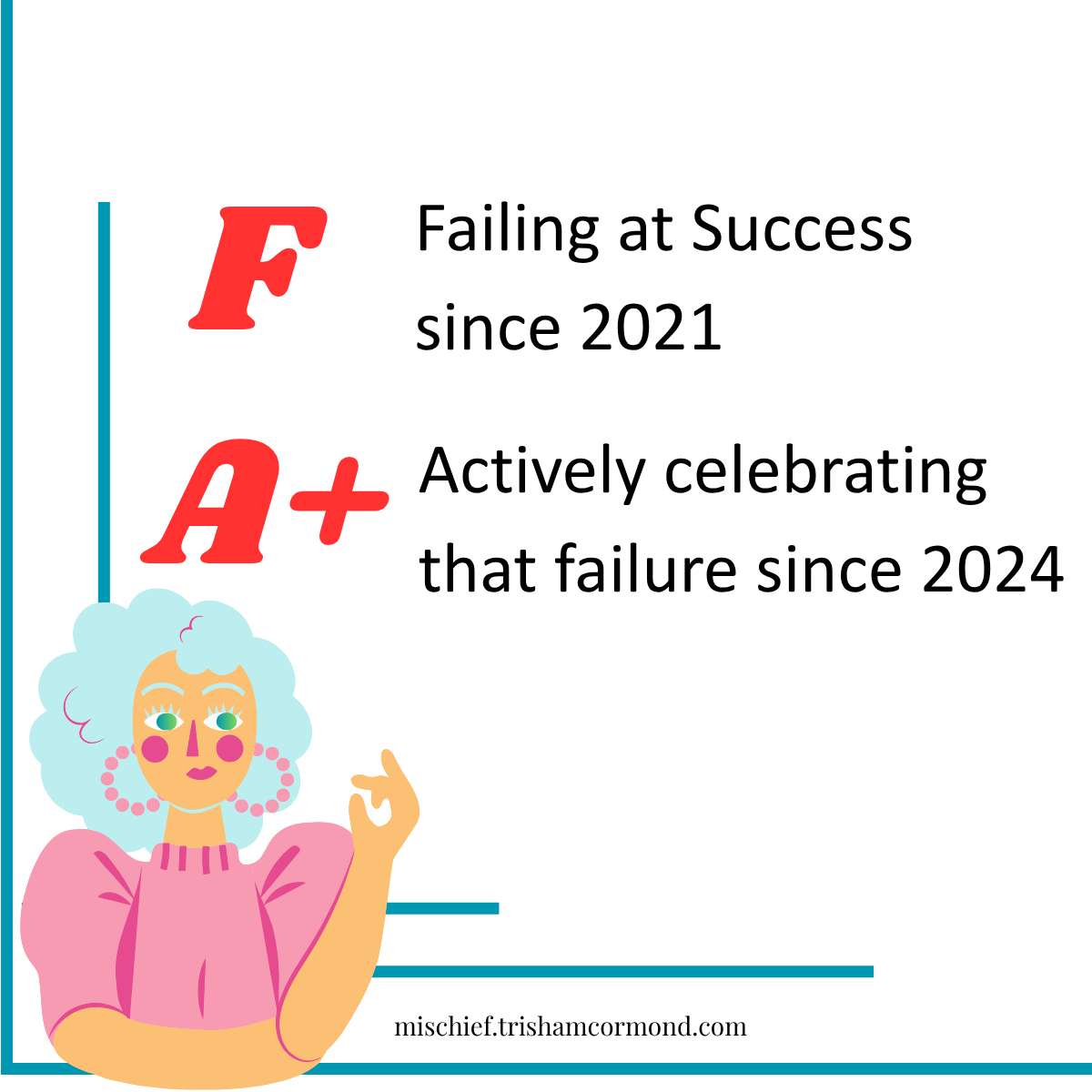
And then one day, I got it. I am a failure.
I am a failure at believing that my work only matters for the paycheck.
I am a failure at believing government must give in to corporate greed.
I am a failure at believing “this is the way it’s always been” is a reason for people to stay hungry and unhoused.
I am a failure at believing we cannot make changes.
I have failed miserably at believing I need to hate my life today so I can save money for tomorrow.
And I will continue to be a failure at all of those things.
If empathy is the greatest threat to patriarchy, white supremacy, and the entire colonial project, then please, give me a big fat F.
I am proud to be a failure at cruelty.
It has taken me a long time to understand that failing at success in an unjust world is exactly what we need right now.
We need people who are failing to be obedient.
We need people who are failing to give up their imagination and creativity for a bigger paycheque.
We need people who have decided the price of fitting in, of success, is too high and instead have decided to fail at colonialism and embrace the world of mistakes learning how to build a sustainable future requires.
One day, prepping for a presentation, I came across this quote:
The plain fact is that the planet does not need more successful people. But it does desperately need more peacemakers, healers, restorers, storytellers, and lovers of every kind. It needs people who live well in their places. It needs people of moral courage willing to join the fight to make the world habitable and humane. And these qualities have little to do with success as we have defined it.
~ David W. Orr
Reading this is inspiring. Of course this is what we need, just like Einstein said in 1955. But being inspired isn’t the same as being the peacemaker, the healer, or the restorer in a world that rewards obedience rather than curiosity. I had to learn how to build a different future.
Making Peace with Being a Peacemaker
There is a colonial desire to tell other people what to do rather than fixing their own shit; to leave a mess everywhere and then act all surprised when someone points it out and says “Hey, help clean this up.” In fact, success depends on ignoring the mess.
I have not found any magic wand that would enable the colonial version of success while also changing the system that has created the harm we currently live with. So, I continue to fail at colonialism. In fact, my failures are becoming more pronounced. That Community Social Recovery Model I mentioned earlier? I hope this becomes one of my greatest failures at colonial thinking.
I refused to be obedient during my own recovery and healing from complex post-traumatic stress disorder because I needed to reclaim my autonomy.
I was in pain, not stupid. I wanted to build my life, not someone else’s. So I was defiant and spent 18 months on research, I learned my trauma responses are normal, not pathology.
What Now?
To quote Rumi and Cohen, the cracks are where the light gets in. My pain opened me to the wisdom on what is missing, what was taken and now needs to be restored.
This choice is not just personal, it is political. I decide when I am whole, no one else; I will no longer be profitably compliant. And since I am not special, I am pretty sure most people feel the same: they want a life they feel good in, not one that looks good to other people. They too, want to fail at being cruel.
Communities are the same, just on a larger scale. So instead of a model built on compliance, I built a community recovery model built on the same curiosity that I used for me: What does the community already know? How can the community be supported to use their knowledge most effectively?
Change feels like failure, sure. But only at first, because learning how to do something different is going to be hard. Eventually you too, might relish in failing because it opens up so many more ways to be at peace.
If you want to talk about what it’s like to build a business when you have Complex Post-Traumatic Stress Disorder, I have two spots a month available here. No coaching, no cost, just a chat.
Also: I go live most Fridays at 11:30 am MT to talk about the community recovery model. Find the first one here
Love this reframe, Trish!
Thank you! Just what I needed to hear today <3