

Everyone knows fires burn down houses and floods wash away belongings or mire them in mud. After disasters, there is a plan and a process to physically and economically recover. What is missing is acknowledgment of the disruption to social networks that support psychological and mental wellness for people and their communities, and appropriate community supports to rebuild those networks.
The Community Social Recovery Model is an evidence-based model that nurtures social networks and rebuilds and sustains the capacity of people in the community to recover. As disasters become more common, proactively building stronger social networks becomes a key component of individual and community resilience and recovery capacity.
Impacts of Disasters
Disasters increase social isolation by disrupting or completely destroying social networks people have relied on to maintain wellness (Makwana, 2019). As my own research found, there is a distinction between disrupting interpersonal relationships with individuals and disrupting or fracturing relationships with the community organizations people rely on when they are vulnerable (McOrmond & Babb, 2004).
The initial outpouring of support after disasters contrasts sharply with isolation people experience when it is cut off and community ties are still not reestablished (Kaniasty, 2020), leaving people with less psychological capacity to recover.
In addition, male violence against women and children after disasters is well-documented. For example: After Hurricane Maria in Puerto Rico in 2017, domestic violence providers saw a 62% increase in requests for survivor related services and a 47% surge in requests for violence prevention and education resources (González-Ramírez, 2018). After the 2013 Southern Alberta Floods, CBC reported a surge in demand at Calgary women’s shelters.
Children are affected too, and time does not heal all wounds. Researchers (Brown, et al., 2019) found that young people (13-17) affected by the 2016 Fort McMurray wildfires reported higher levels of PTSD, major depressive disorder and anxiety disorders 18 months after the event than young people who lived in a comparable Alberta community not affected by a disaster (Red Deer).
Increase in substance use disorders after disasters is also well-documented and again, without appropriate supports the psychological distress coupled with social and medical supports being disrupted, the long-term impacts trend negative (Alexander & Ward, 2018).
Current Approach
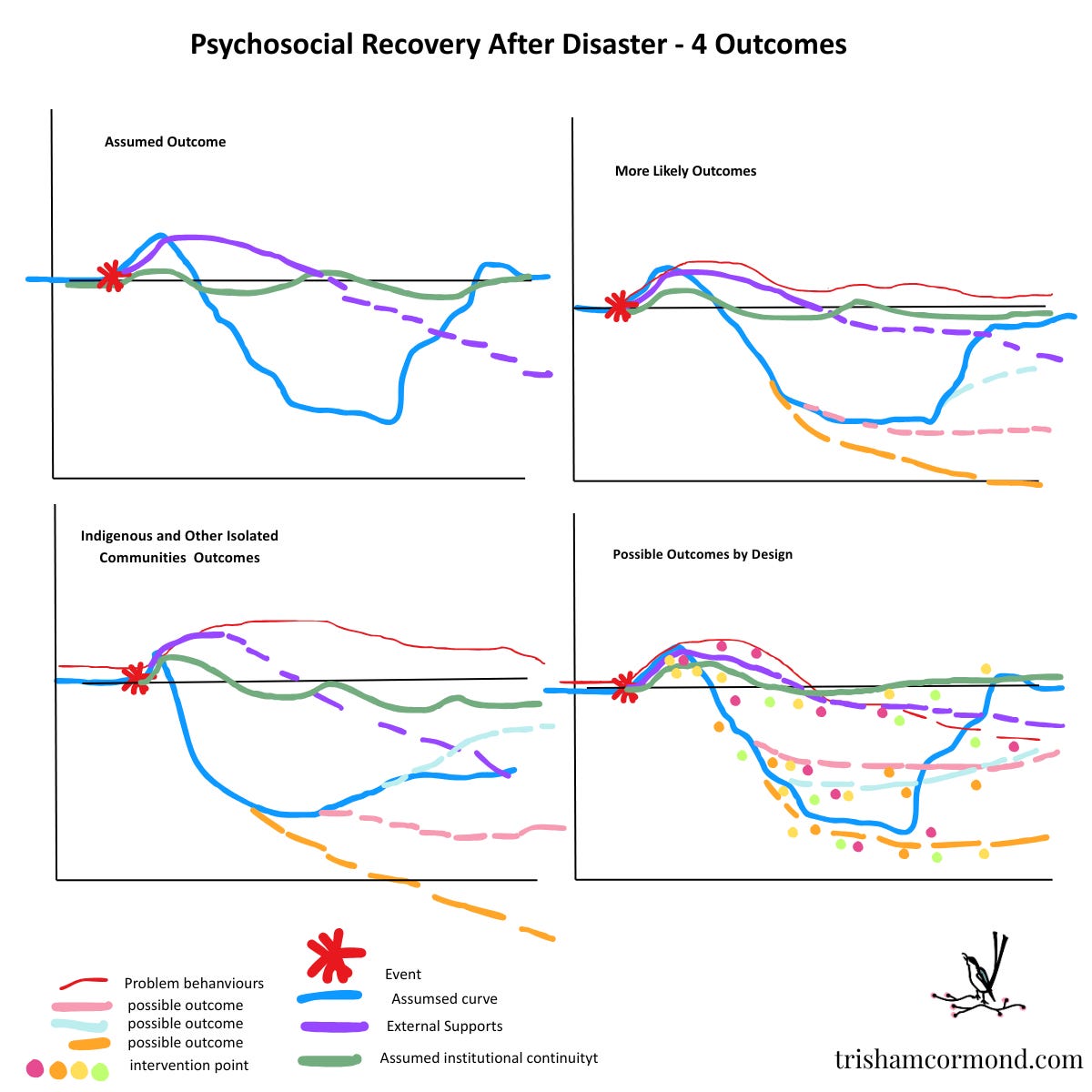
Unfortunately there is an unspoken belief among emergency management developed from a Western worldview that if you build the buildings and provide money to large businesses to recover, community social networks will return to the baseline before the event (McOrmond, 2025).
However, the research on youth mental health from Fort McMurray, and the consistent increase in male violence against women and children after disasters first theorised in the late 1980s, demonstrate that mental health concerns and behaviour concerns persist and may worsen without targeted supports that provide healthy social models.
Community-oriented social recovery for neighbourhoods or communities that are the most vulnerable and not well-resourced are necessary. Otherwise the baseline expenditures on social services will not meet the need when returned to pre-disaster levels because people will need more, not less, supports over time.
What Can Be Done
In 1992, Judith Herman stated “No one can recover from trauma alone” because first we need to feel safe, emotionally as well as physically - we need to trust the people we are around and that we will be able to make decisions about our future once we have had time to grieve.
Herman developed a three-stage model:
Safety and security
Grief and empowerment
Integration and vision
To be truly able to address the impacts of disasters, particularly evacuations, on communities people need to be well enough to build the infrastructure and work in the businesses that are supported through economic recovery. People need to feel safe in their communities, grieve what they have lost, and have an opportunity to create a new vision of their future.
Why This Matters
According to research from the CSA Public Policy Centre, April 2026, estimates that the mental health crisis is costing Canada $180billion a year, (up from $67 billion in 2011, adjusted dollars). Of that, $110 billion is spent on disability claims, benefits, and lost productivity by employers.
Furthermore, by 2050 the annual costs of poor mental health will be $600 billion which is 20% of Canada’s GDP. If we want to change that trajectory and ensure we can build a sustainable future and are able to reduce the impact of disasters on our mental health, we need to intentionally invest in Community Social Recovery after disasters.
People who feel safe in their community build communities that are safe. To feel safe, people need to know they are not alone – that someone will be there for them, not just in a therapeutic sense – but in relationship.
Community Social Recovery Model is the first stage of restoring the community fabric that is frayed due to disasters and the isolation and fear people experience. This is the basic format:
Month 1 and 2 create the structure that builds safety and connection among community members
Month 3 and 4 is a space to talk about grief, support others in their loss, and begin to imagine what they would like to be able to do in the future
Month 5 and 6 are the development and planning time when people begin to flex their agency and determine how to move forward together in a good way
Resilience is not an accident, it is an intentional choice that starts with supporting healthy communities.
Want to work with Trisha? Every community is different and has different needs. Book a 30-minute call with me to talk about what your community needs and how I can support you
Also, I will be starting Substack lives on community social recovery models August 20 at 11:00am MT/1:00pm ET to answer your questions and share information. Subscribe to be notified when scheduled.
References
Alexander AC, Ward KD. Understanding Postdisaster Substance Use and Psychological Distress Using Concepts from the Self-Medication Hypothesis and Social Cognitive Theory. J Psychoactive Drugs. 2018 Apr-Jun;50(2):177-186. doi: 10.1080/02791072.2017.1397304. Epub 2017 Nov 10. PMID: 29125424; PMCID: PMC6101235. https://pmc.ncbi.nlm.nih.gov/articles/PMC6101235/
Brown MRG, Agyapong V, Greenshaw AJ, Cribben I, Brett-MacLean P, Drolet J, McDonald-Harker C, Omeje J, Mankowsi M, Noble S, Kitching D, Silverstone PH. After the Fort McMurray wildfire there are significant increases in mental health symptoms in grade 7-12 students compared to controls. BMC Psychiatry. 2019 Jan 10;19(1):18. doi: 10.1186/s12888-018-2007-1. Erratum in: BMC Psychiatry. 2019 Mar 26;19(1):97. doi: 10.1186/s12888-019-2074-y. PMID: 30630501; PMCID: PMC6329184. https://pmc.ncbi.nlm.nih.gov/articles/PMC6329184/
González-Ramírez, A (2018) ““We Survived”: A Year After Hurricane Maria, 25 Puerto Rican Women Tell Their Story for Refinery29.” https://www.refinery29.com/en-us/2018/09/209761/hurricane-maria-anniversary-puerto-rico-women-experience
Kaniasty, K (2020) “Social support, interpersonal, and community dynamics following disasters caused by natural hazards”, Current Opinion in Psychology, Volume 32, Pages 105-109,
ISSN 2352-250X,
https://doi.org/10.1016/j.copsyc.2019.07.026.
McOrmond, T and Babb, P “Conceptualising and defining social capital with a · policy relevant focus” InSiena Group meeting 2005
McOrmond, T (2025) “Rebuilding community (while rebuilding the community): A holistic recovery model for the 21st century” Haznet Summer 2025. https://haznet.ca/rebuilding-community-rebuilding-community-holistic-recovery-model-21st-century/