

In 2024, inspired by work Dominique Rivera at Fictive Kin Labs was doing, I started a Tools for Trauma dictionary for myself. A way of tracking the things that got me through panic attacks and hard interviews and making dinner for my kids when I’d rather be curled up in a ball.
As I worked, it felt less right. The truth is, trauma is not going anywhere and the systemic causes of it need to be addressed. We don’t get trauma, heal from it, and then go back to our old lives. We cannot because we are not the same people anymore. So what next? How do we grow into this new person?
We are at a time in our world where even weary and overwhelmed, we need to be able to support ourselves in spaces that are not designed for us if we want to be able to participate in the larger economy.
One of the truths I learned early in life was that just because I should be able to do something, or I had a right, didn’t mean I was protected from the consequences of other people’s actions.
For example, pedestrians totally have the right of way in a crosswalk, but a car is still bigger and dead is still dead even if you “had the right of way” so always look both ways and don’t expect cars to just stop for you, you know?
When I was diagnosed with complex post traumatic stress disorder (CPTSD) it was essentially considered a lifetime disability. I could receive long-term disability until I hit retirement, at which time I would then receive my pension.
Scared to change. More scared of staying the same
The idea of spending the next 40 years getting money every month seemed both enticing and like a bit of a punishment. I felt like I was always going to be at the mercy of my former employer: the one who created this whole mess.
I wanted to be free to live my life without worry; and I wanted to be involved in the labour market – I have a lot of skills and a lot of knowledge, and I wanted to be able to share that with my community. I also know research shows that connection to the labour market is one of the indicators of mental well-being.
According to the Mental Health Commission of Canada (2025), employment reduces the likelihood of death by suicide, decreases isolation and substance use disorder and increases self-esteem and relational skills.
And so, in my usual fly by the seat of my pants way, I did the basic worker’s comp CPTSD ten (or twelve?) week program, then I decided to quit my fucking job that offered me the long-term disability benefits and instead go out and find a different job.
The logic behind this is long and convoluted and maybe one day I’ll understand it enough to write a coherent essay but suffice it to say that adventure challenged me in ways I didn’t even know I could be challenged. And because I am the sole breadwinner for me and my two kids, it also meant I could not quit. Even if there were weeks where it seemed like I had, a lot of that time was me marshalling strength to step up again.
After I launched a business, I still had a lot to learn and so to pay the bills, I took a position with an organization that helped me understand the programs that are available to help people return to work do not prepare us to return to the workplace. Particularly as a lot of workplaces are not filled with people who have done their own personal growth.
So, as much as I want cognitive behavioural therapy (CBT) to be the answer, if it were that easy, mental illness wouldn’t be costing the Canadian economy $180 billion a year (Sellers, 2026). I found that CBT relied too much on control and routine, things that were anathema to me.
Routine as a single mum with two kids who are both busy as well as having a full-time job and working to overcome a childhood of abuse and a history of intergenerational and transgenerational trauma, was almost impossible. Maybe for some people routine is possible and desirable, for me, routine beyond laundry is done on Mondays and groceries are bought every second Tuesday (hopefully I remember to order them online) was about all I had available to me.
And control? HA!
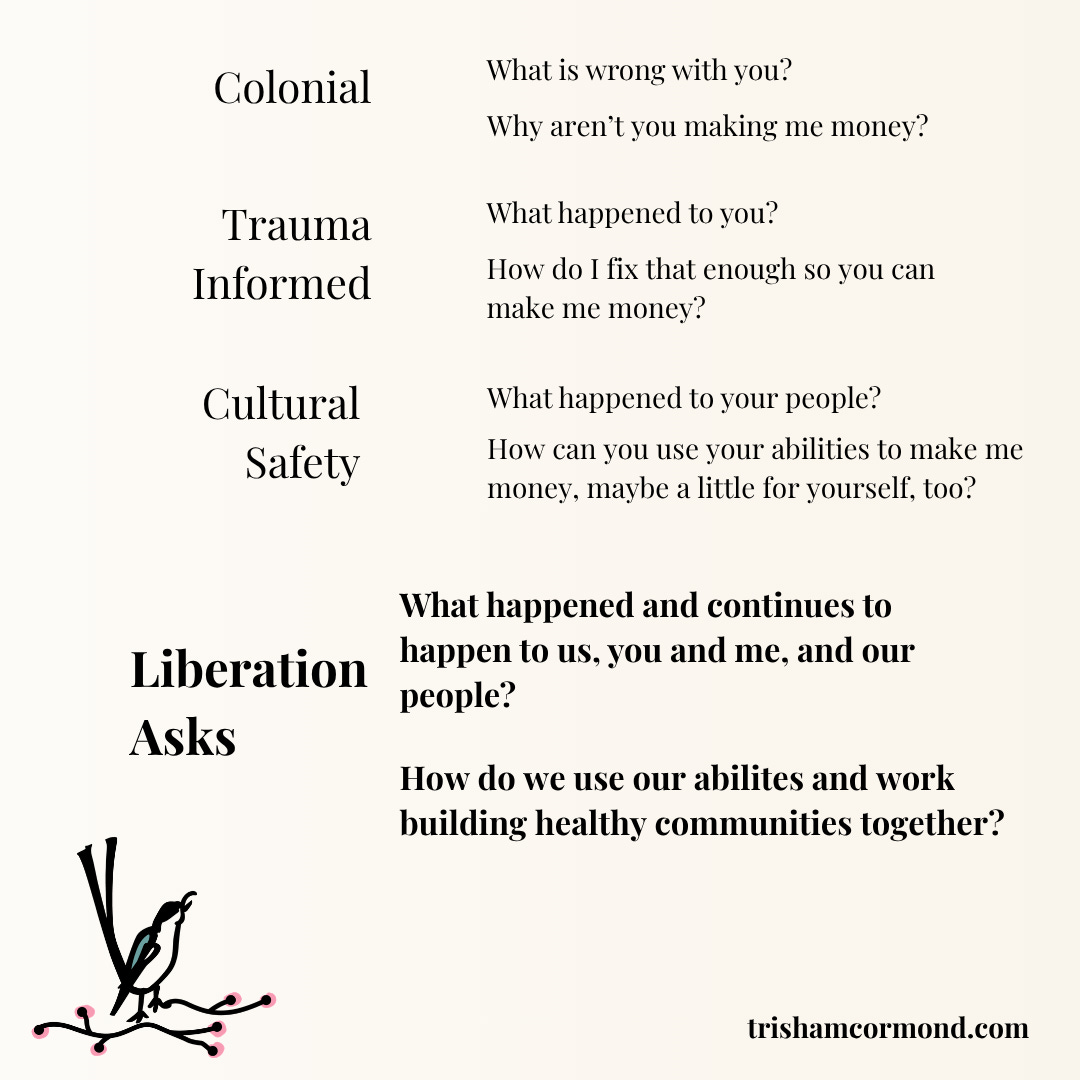
Through this process, I realised I had created all sorts of mechanisms for helping me regain and eventually maintain my equilibrium in a world not designed for me. I was no longer waiting for the world to change to accommodate me, I began to build a toolkit that gave me the tools to be in the world and be comfortable being myself. I had created a set of tools that supported my growth into the kind of person who not only lived and loved in the world but was now committed to and capable of working to build a better one for everyone.
These became the tools I used for my own liberation, and I want to start sharing them.
Why am I writing this?
I am building a Tools for Liberation Handbook because CBT and yoga aren’t the answers in a system that tells you your worth is attached to all the things you can buy.
And because I need a list of things to do instead of day-drink when I listen to the news.
I am also only starting to figure out how to build a business that makes sense for me and so this is a work in progress that I am happy to share. Over time I plan to have a tool for every letter but if I wait until they are all written before I post, it will never happen.
It feels like on every side, things we once held to be true are disappearing and getting up and doing the day is getting harder. The additional demands we continue to take on will not change if we do not find a way to create that change in our lives. This Handbook is filled with tools to help you develop emotional regulation skills so you can stay present in difficult situations or come back to them as needed.
And emotional regulation, to be clear, is not always calm. Sometimes it is a long fast walk to help calm down after spending an hour sorting out someone else’s mistake.
Speaking of walks, there are increasing frustrations because you stay on the hold line for customer service from the internet provider, and you on hold longer than before and you are doing a whole bunch of number pressing. And if they make a mistake, they don’t let you know – it’s up to you to find out.
There are different ways to approach situations like this. Some of them create liberation and some create conflict. Having a list of tools you can reference, and practice when you know you want to make changes are worth the work to change is one way to begin to set yourself free.
You decide how you act, and how you feel about those actions. No one else. I am still figuring out how to express this.
Using these tools will begin to help you create space in your day and in moments of tension and conflict so you can experience liberation even in systems that are not designed to be liberatory. And this is how we begin to change systems that don’t work for people.
Interested in the tools? Request access here
Want to talk about what it’s like to build a business when you have Complex Post-Traumatic Stress Disorder? Not coaching, no cost, just a chat. I have two spots a month available here