

The Realization
It was the same as every other day. I was applying for a lateral move in government and listing all the things I had done in my current role. I thought “Is this going to be any different than here?”
I meant “Are the lives of Albertans going to be better if I take this role? Will people’s lives materially improve?”
Sure I was making a great salary, with benefits and a fabulous pension. I worked in a really nice building and went for team building events, had vacations, and travelled to conferences. I had a Health Spending Account and a gym in my office building. Things that all workplaces should have.
But more and more those good things were coming at the cost of working on policy decisions that made life harder for people who come from where I came from. I was watching rights and social supports that people had been advocating for and defending for decades, like health care and public education, being stripped away after small group meetings in private offices that were never brought to the public the civil service is charged to govern.
One day, when discussing options on a briefing note, an Assistant Deputy Minister actually laughed in my face and said, “Trisha, you and your “values.” No one cares. Just do what you’re told.”
The idea I would spend my life just doing what I am told, felt distinctly like a stupid way to live my life. I believed in the role of the civil service to advocate for the public we served. To discharge our duties with respect, accountability, integrity, and excellence (my former employer’s values) so everyone had the opportunity to live a fulfilling life.
Where was the excellence in saying to a staff member “You and your values. No one cares.”
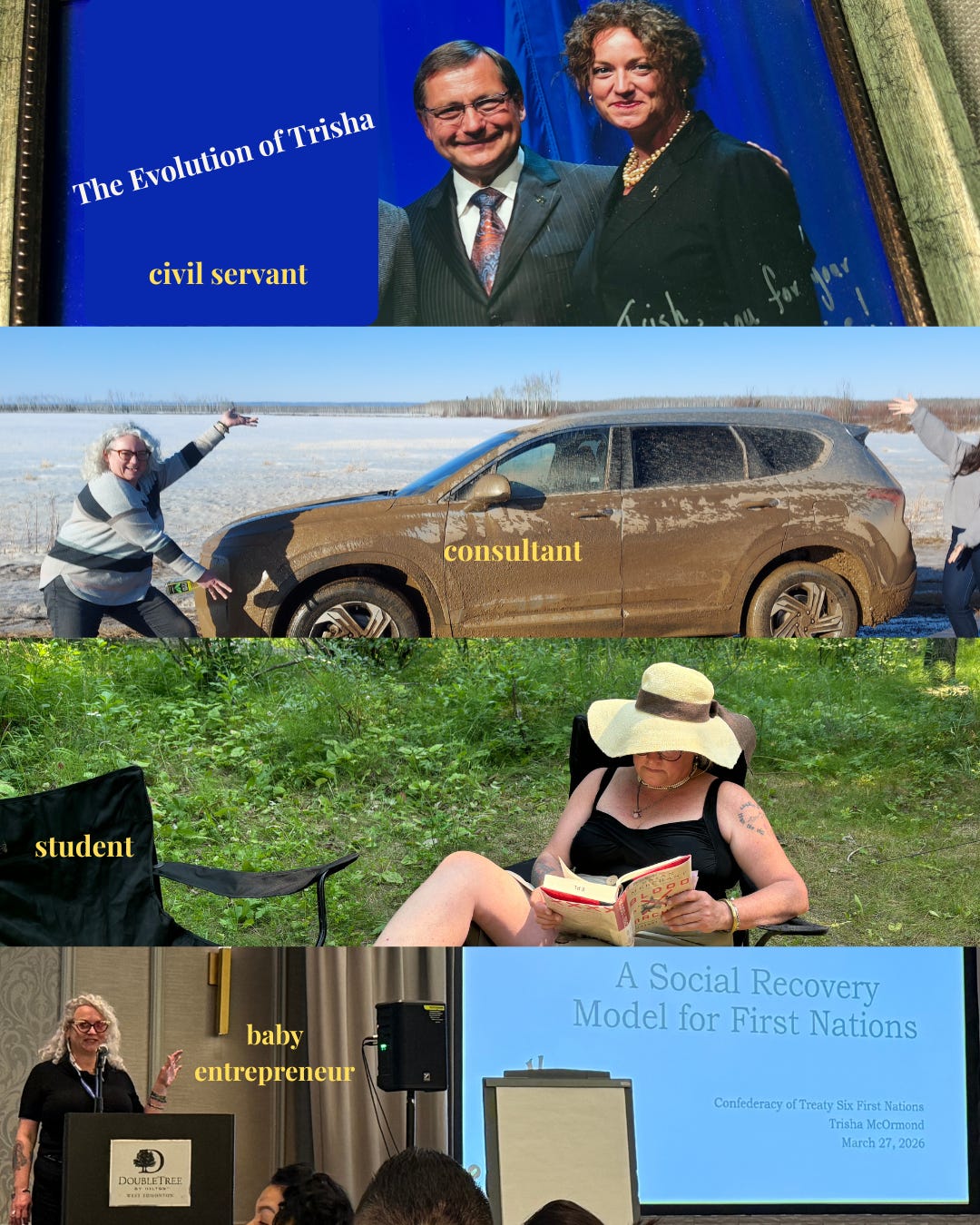
The idea of spending the next 20 years working to build a world I didn’t believe in suddenly felt crushing. I have two children and believe we are responsible for long view thinking, or miyo pimatisiwin: making sure how we live now leaves the world better, not worse, for the future.
Eventually I realised that staying in government might not be possible. Increasingly leadership and politicians treated staff with contempt by ignoring basic procedures when it suited their aims, but being taskmasters for the public.
I was tired of doing the same thing over and over again because my bosses wanted the same results. What did that make me?
The Observation
As a single mum it was scary, the idea of leaving. I did a few things like made sure all major expenses that my benefits covered were done as quickly as possible, paying the maximum co-pay each month.
I decided better the devil I know, and so rather than looking for a different role in the same employer, I joined what I thought was a solid business development program and began to map out a plan. It was 2018, I gave myself 6 years to build a path out of government which would coincide with when my kids graduated high school.
It was a great plan. With one exception: I did not account for the actions of others. In early 2019, a man touched my body in an inappropriate way without my permission at a meeting and the organization’s representative responded with “He’s a good guy. I’m sure he didn’t mean anything by it.”
In August 2019 I was put on short-term leave. By January 2020, I was diagnosed with Complex Post-Traumatic Stress Disorder (cptsd), put on long-term disability, and then went to rehabilitation through Workers Compensation Board.
In January 2021, I had finished rehab and my employer reached out to say they “had found somewhere <<sigh>> that was willing to accommodate my working restrictions.” (The working restrictions were not to have to work with the man who touched my body without my permission. The team he ran had multiple complaints against it from internal and external clients.)
And in that moment I realised nothing was ever going to change with my former employer. I could go back and have a great ‘job’ with a good salary and benefits.
But the people making decisions were not making good decisions. If this is how they were going to treat a staff member they knew and had a legal responsibility toward, why would they treat the public any better?
So I quit.
Just like that.
No notice, no real plan other than find another job.
With CPTSD.
hahaha
It was terrifying. But I was so angry! I was angry that I had believed in the people I worked with, that they would actually act in ways that aligned with their values. I believed that people who were protected by the union and had a Code of Ethics, paid by the taxpayer, would use that empowerment to act in prosocial ways.
I was wrong.
One day, hiking with a former colleague who had also left the same employer, she told me she had taken a new, very senior job responsible for delivering social programs to a local municipality.
I asked her, excited because I was still looking for somewhere that I could both enjoy the work and also not sell my soul to pay my mortgage, I thought perhaps her new organization might be a fit. “How’s the new job? Are you enjoying the work?”
Her response was “I don’t care. They pay me a lot of money and all I have to do is what I am told to do.”
Which if you aren’t a civil servant is less gross perhaps?, but it just sat bad with me.
If you don’t care about the people you are providing services to, why are you doing the work?
Because the people who defend abusers say “I’m just doing my job” as justification and that seemed like the wrong thing for a civil servant to do.
The In-Between
Leaving government did not automatically lead to understanding. That required series of somethings that landed on my plate over the next couple years while I learned how to not be an angry ex-civil servant:
An employer who defended sexual harassment in the workplace to my face
A consultant I subcontracted to who started to steal my work
Funding cuts that meant contracts not being renewed
A coach who would only help me if I did exactly what I was told, no discussion
An entrepreneur who offered a great project, flashed a lot of cash and bought lavish meals, but never paid my invoice
Stories breaking of government officials having data and not acting on it even when people were dying
Civil servants being promoted for failing to discharge their duties to the public
A business mentor who cancelled our relationship with zero notice after I completed a project for her
The kinds of things that when I worked in government bothered me, but they didn’t take away my ability to pay my mortgage. The role of government as a facilitator for healthy social relations became more clear to me.
And because I was no longer a full-time employee with a boss who yelled at me and people acting like I was over-reacting to our failure to make strategic policy shifts that would set us up for a strong 21st century economy, I also felt:
A constant sense of being a failure
Shame at being a single mum for 16 years
Embarrassment that I left a job on principle and then couldn’t get another one
The failure part: I’d once had a great-paying career, with benefits and vacation and a parking stall. People who I went out for dinner with. Who cares if they defended the guy who thought it was ok to touch me without permission?
What does it matter that they are now writing briefing notes that take rights away from trans kids and teachers, I could have figured out how to work with that. Couldn’t I?
I started to scan government job boards. I began to imagine what it would be like to have a regular paycheck and not worry about having to save for retirement somehow too.
I told my kids. They asked “Have things changed in government, are they making better policy decisions?”
And the answer is no, they aren’t in fact, increasingly I see decisions that are the opposite direction of what we need:
Kids are getting less support in private group homes
Hospitals are gaining senior administrators and losing front-line services
Seniors are receiving less care for more money
People with disabilities are having their benefits cut
Immigrants are losing access to health care
Transportation and education are so underfunded the foundations are cracking
Then they asked “So, why would I want to go back?”
Because I am not good at business. Not even a little bit. I am good at being an academic, I am good at falling for “but you have such great ideas” and being strung along. I am good at listening to people and seeing the patterns that point to the problem. But business - selling my products and services? Not so good. That was why working for government had worked for me: I could do work I believed in and my weirdness wasn’t a liability.
But I am worse at sacrificing my children and their future, I realised being bad at doing something different isn’t a good enough reason to be the person I needed to be to work in government:
* Someone who pretended the science about climate change was open to debate
* Or that you only matter if you make money for someone else
* Or that men were not responsible for the violence they commit against women and children every day with no penalty
* Or that we do not have a responsibility to make sure everyone has a house
* Or that animals and plants have no value other than what can be monetized by capital
I was tired of watching government policy be reimagined as a way to keep people out. And I was sick at the thought of having to write briefing notes or cabinet documents that justified taking away rights or increasing the carbon load in the environment. Going back to government was not an answer.
The epiphany
It is a weird moment, when you realise all the things you thought you wanted are just distractions from being free to be myself. I was in a non-place: a failure because I couldn’t find a way to work successfully in an institution I had admired since I was a child without betraying my values and I was also unable to figure out how to be good at business-doing or assessing the people around me and their ability to assist me.
I couldn’t get another job, I had very few friends, dating was so bad I’d given up, my volunteering attempts were short-lived, and I was estranged from much of my family. These things that existed before I left government, now felt like early warning signs that my failure was not just expected, but imminent.
I fell back into thinking “if even government - the organization that talks about evidence-based governance - doesn’t value my skills, how could I possibly build a business?”
I believed I was a failure by every metric. Except one: My kids continued to be proud of me for not going back to work for government.
That one metric brought me back to my desk, my work station, every day. Sometimes for 5 minutes, sometimes for 15 hours. I realised my goal was to make sure that no one ever felt as alone as I felt when I was a child bouncing between adults.
I decided I wanted to create social policy that centred the wellbeing of children. One that aligned with what I had learned alongside cooking with my gran.
Everyone eats.
If you eat, you work.
If you work, you are part of the decision-making.
If you are part of the decision-making, you make sure everyone eats.
The work
Building something where children were at the centre required me to re-examine my worldview. Why were decisions being made that consistently resulted in worse outcomes for the people about whom the decisions were being made?
Why, with more money circulating in the economy, were more kids going hungry? I understood it was the result of government policy and corporate decisions but what drove that type of decision making?
Why weren’t more of us concerned that people weren’t eating? Until I remembered a conversation I had with a former government colleague:
She and her husband owned 4 rental properties, plus their acreage, and were both executive management in government jobs with a couple of kids. We were out for lunch and she leaned over and said “have you seen the price of broccoli?! I had to tell the kids to put it back the other day. Absolutely ridiculous.”
“Yes, I bought some the other day. It’s my kids’ favourite.” I responded. I made 75% of her salary. My house was worth about the same as her garage. And I was so confused. Who said no to their kids when they asked for broccoli?
Turning back to her menu, “Bit rich for me.” she clucked.
Recalling that conversation, I finally understood we fundamentally saw the world differently. For me, my kids and good food and time doing stupid ish is non-negotiable. There is not enough money in the world for me to sell out my kids’ future, or the future of any kid.
For me, safety existed in knowing my kids had a liveable future. For her, money meant safety. But money isn’t food, it isn’t water, and it isn’t love. Chasing money can’t make us safe because there are no natural laws to money, no loyalty.
Deciding to centre the well-being of kids and other vulnerable people, instead of money, has consequences. For me, it means I have had to learn how to do this work in a way that is aligned with my values. Decisions and outcomes that create a better future, rather than contributing to the current destruction, require radical changes.
These changes are not clearly sign-posted either. The future I am headed into is uncertain, not clearly mapped out like my government career was. In-post annual increases, clear promotion-track, benefits, long-term supplier contracts, and 5 years change-management plans: all of these are artifacts that were very reassuring until I started to pay attention to the impact I was having on the long-term future for my kids and their friends.
So I changed my worldview instead and began to ask “what needs to be done to make the world safe for our kids again?”
The present
It’s a wild place to be. There are days I am so overwhelmed by what I have taken on: building a business that is about enriching communities, rather than extracting from them while also navigating the world with cptsd and a long history of abuse. What I remind myself of daily however, is this: any change good or bad, is work. If work is how I change, then I can make my work medicine for me and for my community.
Yet, just because I am good at doing things, that doesn’t mean the things I am doing are good. That part of my personal growth, becoming something more than a person who followed the rules for praise, will continue. This is the know better, do better part of the curriculum Maya Angelou told us about.
There are times when I regret leaving government, the steady paycheck and the guaranteed retirement dollars. But then I look at the decisions being made right now and I ask myself: “Would you be happy working in that environment?”
And the answer is no. If I had stayed on disability, I would never have felt safe either because those rules can also be changed.
So somehow I have landed in the one place that makes happy and safe possible: betting on myself.
Doing Better.
Want to talk about what it’s like to build a business when you have Complex Post-Traumatic Stress Disorder? Not coaching, no cost, just a chat. I have two spots a month available here