


A few weeks ago a woman got on stage and read a land acknowledgement. It was not well-received by the Indigenous audience members. Complaints were made to the organizer and quick action on their part would have easily restored the relationship.
On this day however, the organizer’s response was a masterclass in how not to handle a complaint. Fortunately, it is easy to avoid - if you know how.
original collage, trisha mcormond
So, today I want to talk about what happened, how to avoid it, and what if it still goes wrong? I end the essay with Do’s and Don’t’s for organizers and 6 things to remember to protect yourself from relational violence.
Let’s get started.
Avoiding Complaints - Easy Button
(boring, safe, and no shame)
The easiest way to avoid a complaint is to use a pre-written land acknowledgement. These are innocuous, a bit bland, and most importantly achieve the objective of acknowledging where you are.
But that might not be possible. Or as more people are learning about Land Acknowledgements and reconciliation, some want to write their own as a way of demonstrating their commitment to learning and moving forward in a good way.
This decision is courageous and the writer should be supported by the organization for which they are preparing the land acknowledgement.
A colleague, Matthew Dyck, has created a cool land acknowledgement generator called Open in a Good Way. This tool helps you navigate the process with a variety of tools for opening and closing statements, as well as prayer and reflection. It’s a good place to start.
If you personally want more flexibility, or organizers who want to have more freedom in development then it is important to remember the obligations to the writer, the audience, and the People whose land is being acknowledged that need to be met.
Obligations for Organizers who Want to do More
Here are 4 obligations for organizers to ensure land acknowledgements are developed in a good way:
Have clear guidelines on what language is required and what language is inappropriate
Provide information on how to write a good land acknowledgement (links below) to the author.
Review the draft land acknowledgement for factual accuracy and cultural sensitivity. Read it out loud to someone who you trust to provide honest feedback
If the person giving the land acknowledgement has never given one before, as the organizer you are responsible for providing necessary education and support to prepare and deliver the land acknowledgement. This support is best from someone with experience and cultural knowledge
It’s Written, Now What? Continued Obligations
The organizer’s obligations to the audience and the people continue beyond the preparation of the land acknowledgement. Even with these steps in place, mistakes are possible during the deliver. Yes, even by the most well-meaning, well-educated, well-connected people. That’s what happened a few weeks ago.
Why? Because mistakes are unavoidable when you are learning to do something new and growing. Mistakes are also deeply uncomfortable to people who were raised in Western systems.
I was involved in the event, the complaint and the aftermath - which has been unpleasant - including my own resignation from an organization I really enjoyed being a part of. I want to share what I learned to avoid this happening to others, and to set you up for success if you find yourself in the same position.
What is a Land Acknowledgement?
Land acknowledgements have existed long before settler colonialism landed on Turtle Island. For the purposes of this essay however, I am writing specifically about Land Acknowledgements as they are currently used in Canada by predominantly non-Indigenous organizations and individuals.
A land acknowledgement is a statement by a business or organization, and often something read at event openings, to acknowledge who stewarded the land and thank the people who live on these lands under colonial government rule. Many businesses and organizations have land acknowledgements on their websites and email signatures, as do some individuals.
The current iteration grew out of the Truth and Reconciliation Commission Call to Action 92, which calls on businesses to acknowledge their responsibilities in reconciliation, including building respectful relationships with First Nation, Metis, and Inuit communities and people. Acknowledging the land is one way of increasing cultural awareness and creating a shared understanding of history.
If you want to write your own, there are a lot of resources available on how to write a land acknowledgement in a good way. One of my favourites to help you understand the purpose and practice is available from Atlantic Canada PressBooks:
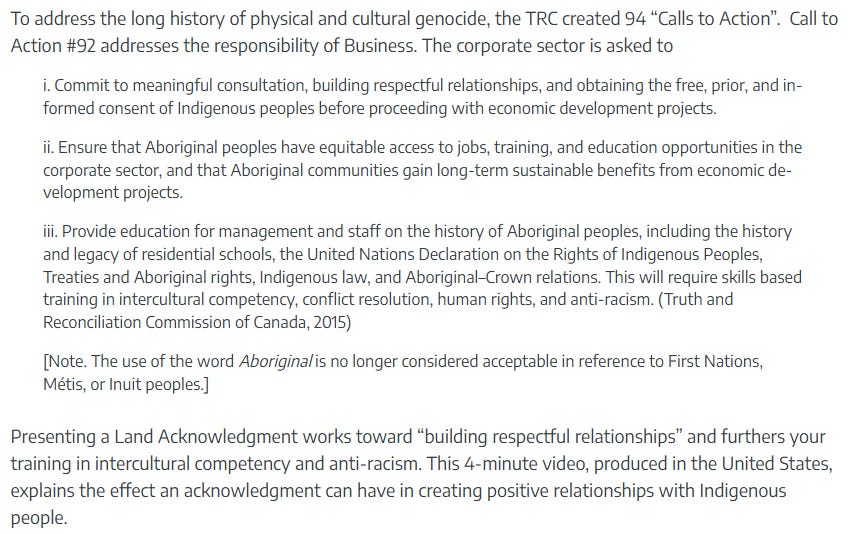
source: Atlantic Canada Books
If you want to deepen your understanding why we acknowledge the land, another great resource that provides some history of land acknowledgements with historical context is from the Canadian Museum Association.
Understanding the history of acknowledging the land helps create a more meaningful relationship between the person giving the acknowledgement and the people receiving it, as well as the attendees of the event or patrons of the business.
Even with all this information, and the best of intentions, sometimes Land Acknowledgements go wrong. And sometimes people then find the organizer and complain.
If you are that organizer, here is my list of Do’s and Don’t’s
Got Complaints? Organizer Do’s and Don’t’s
Scenario:
The land acknowledgment was historically inaccurate and culturally insensitive.
The person reading it was older and very nervous.
Three Indigenous youth complained to me as a representative of an organization that was part of the organizing committee and had invited the youth to participate
I asked the youth if they wanted to let the organizer know how they felt, one of them said yes.
We approached the organizer to raise concerns
How to avoid turning a mistake into a racism, the Dos and Don’t’s if someone complains at the event:
Do
Let the person speak freely about their concerns at first. They are hurt and need a place to express that hurt.
Acknowledge you have heard what they said by repeating back the main point and ask for confirmation that you have understood their concerns correctly
Ask if they have anything else to add
Apologize.
Ask if they need anything in this moment
Ask what they need to experience relationship repair (sometimes people just need to voice their concerns and be acknowledged and it isn’t any more complicated than that)
Identify whether or not that is possible
If possible, identify possible timeline (if needed), and act
If not possible, explain why and ask if you can provide an alternative
Act on the final, agreed repair
Don’t
Interrupt the person who has concerns when they start to speak. This isn’t about you and how you feel. You made the mistake and now you have to be accountable for the injury
Remain emotionally centered rather than expecting the person making the complaint to soothe your shame or guilt
Say “I hate land acknowledgements” to the person raising the concern. If you hate them, why are you doing them?
Say “I have learned so much from my Indigenous friend” because if you are interrupting, clearly you have not learned from said “Indigenous Friend”
Tell the person who has raised concerns why they are wrong. Especially if you are old and white
Blame the person who made the mistake. Particularly if said person has no experience. You are the organizer, do your job
Explain why it wasn’t the problem we think it is
Defend why you did not review the land acknowledgement
Explain there are more important issues to be dealt with and this one has to wait
But say the concerns are raised, and you - as the organizer responsible for the land acknowledgement that created the concerns - act from the Don’t category more than from the Do category. Can you recover?
Yes you can. Because most Indigenous people recognise that this is a journey, mistakes happen, and it takes courage to recognize and admit when a mistake has been made and an injury has been caused.
Recovering From The “I Did a Don’t” Category
Indigenous worldview does not expect perfection. Learning curves and different ways of experiencing responsibility are recognized as a part of everyone’s journey. This is the only way we are able to expand our skills is by being bad at things until we learn to be good at things.
However, Indigenous worldview does require accountability for relational violence. This accountability is required to repair the damage and restore trust between parties for the future.
If you are not able to provide these, you will create more conflict and I would recommend you do some reflection on why you want to take a leadership role if you are not willing to also accept the leadership obligations.
There are three non-negotiables:
When recovering from the “I Did a Don’t” you must accept the issue has evolved from the original concern
Recognise you are part of the problem
Respecting the person, and your relationship with them, as they work to address the concerns.
A key part of respect? Do not lie about what you’ve done. Do not talk behind people’s back. We find out and you look like an idiot.
Once you accept these non-negotiables, there are a few things you can do to try and salvage a working relationship. It is important to realize however, you have done significant harm and it is unlikely the person who raised concerns will trust you again quickly.
First you must accept accountability and name what it is you have done and how it has harmed the other person.
Return to the Do’s and Don’t’s above
Bad Recovery Example
Here is an example of the wrong approach and why. The example uses words that mean concern and commitment, but the email demonstrates the exact opposite.
First, the full email, including my response at the top:
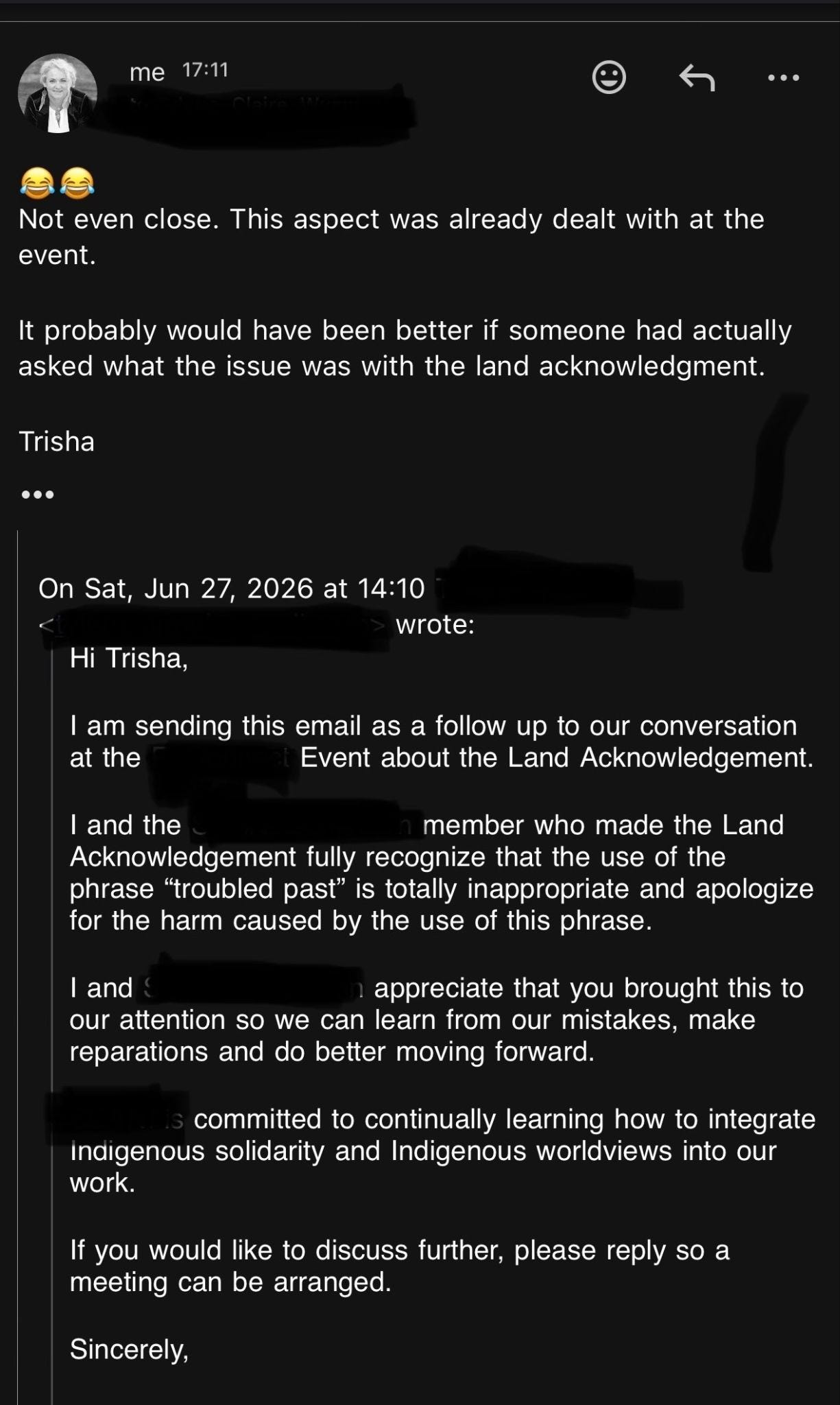
Now, here’s the breakdown of what went wrong in this email response:

1. No one has asked me why I continued to raise the issue so this is starting off on the wrong foot. I already know the writer is not overly concerned with their apology because they don’t know, or care to know, why they are apologizing.

2. First, don’t lie. You do not appreciate that I brought this to your attention so why are you saying you do? If you are committed to Indigenous worldview, as you say below, you would know that honesty and truth are two of the seven teachings so we take that -ish serious.
Also, I don’t know how you learn from mistakes if you don’t ask what the mistakes were or how to correct them.

3. A commitment to “continually learning how to integrate Indigenous solidarity and Indigenous worldview” feels a bit like I am being chastised for doubting their sincerity because their actions are not following the sprinkling in several $10 phrases from acceptable journals.

4. This sentence is deceptive. It looks like the writer is making room for the recipient to decide. But the start “If you would like” is not an invitation to repair the relationship, it is a way of evading responsibility by placing the onus on the injured party. Kind of tedious, definitely immature.
My Response
I decided to turn my response into something everyone can benefit from and wrote this essay. I chose not to discuss this with the individual any further because I don’t waste my time meeting with people who think they are better than me.
No one has my permission to belittle me as a way to make themselves feel good.
My initial response to the email was longer. A bit of an essay on what went wrong. I wrote it, learned a lot about why I was upset, realised the information would be wasted on the organizer. (Takes me a while to catch on sometimes.)
The person who wrote this email explainer to me is experiencing this as though they are the injured party because I raised a concern; that I “just don’t know how hard they worked”. I can do nothing to change their mind, but I can share what I have learned with others.
Final observations about this response:
There are a lot of words written in this email that tick the box but have nothing to do with actually committing to change. At this point, the relationship is fractured and requires tenderness and concern.
What do I see here? A person more committed to looking good than doing good. Someone who decided to make their discomfort my fault.
The Rescue that Would Have Had a Higher Success Rate
How could this email have rescued the relationship instead of completely ending it? It’s so simple:
We understand we made a mistake. We are not sure how or where but we are committed to learning, Indigenous solidarity and Indigenous worldview. Are you willing to meet with us to explain what happened and how we can do better in the future?
Instead the organizer chose relational violence. No questions, no curiosity, no invitation.
There are some people who may continue to be willing to engage in a relationship if you get this third part wrong too. As you can tell from my response at the top, I’m not one of them. I have chosen to take a much more enjoyable path:
Protecting Yourself From Relational Violence
I will end with this message to people on the receiving end of relational violence outlined in the email exchange above.
We cannot avoid getting hurt, that is part of life. We can avoid repeat injuries by recognizing signs and having clear boundaries of what is acceptable. If you are on the receiving end of relational violence, here is what you need to remember:
You deserve better. Two chances for redemption are more than sufficient.
Evaluate their actions, not just their words. People who say they are interested and do not ask questions are not interested, they are angry. Walk away from the angry people to avoid being hurt again.
Deciding to end the relationship might be hard, but staying where you and your culture are disrespected is harder because the disrespect will continue to grow, undermining your self-worth
People who cannot admit they have made an error will always attack those who can, usually when you are vulnerable. Avoid people who avoid accountability.
Go beyond comfort. Learn to celebrate standing up to bad behaviour. It’s the most radical thing you can do.
You do not need to be polite to people who have consistently failed to be respectful to you. You can walk away and block their toxic excuses. I do and it feels great.
Most importantly, do not allow one (or twenty-five) selfish individuals make you give up on people. Take risks, meet new people, read new books. Right now, respect yourself and use your voice in small moments so when the big ones come along you you are prepared.
Start now. Start small and when you are scared. That is the only make big changes.
Registration for Indigenous Systems Thinking Crash Course is now open. I’d love to have you join us
Class starts July 23. There are two times 10am-noon and 6pm-8pm MDT. https://www.eventbrite.com/e/indigenous-systems-thinking-a-crash-course-evening-edition-tickets-1992374094550?aff=oddtdtcreator
OR book a 30-minute call to learn about my coaching services https://tidycal.com/trisha2/30discover
Finally, if you want to know more about Indigenous Worldview and what I do? send me an email at trisha@trishamcormond.com