

Paper has always been hard for me: keeping track of documents, knowing what to do with receipts, understanding how to do ‘records management’ have always felt overwhelming. And I used to alphabetize my books by author, year, and series title if needed. I love books, I love libraries for their orderliness. But all the paperwork that exists for all the minutiae required just to be alive, disturbs me.
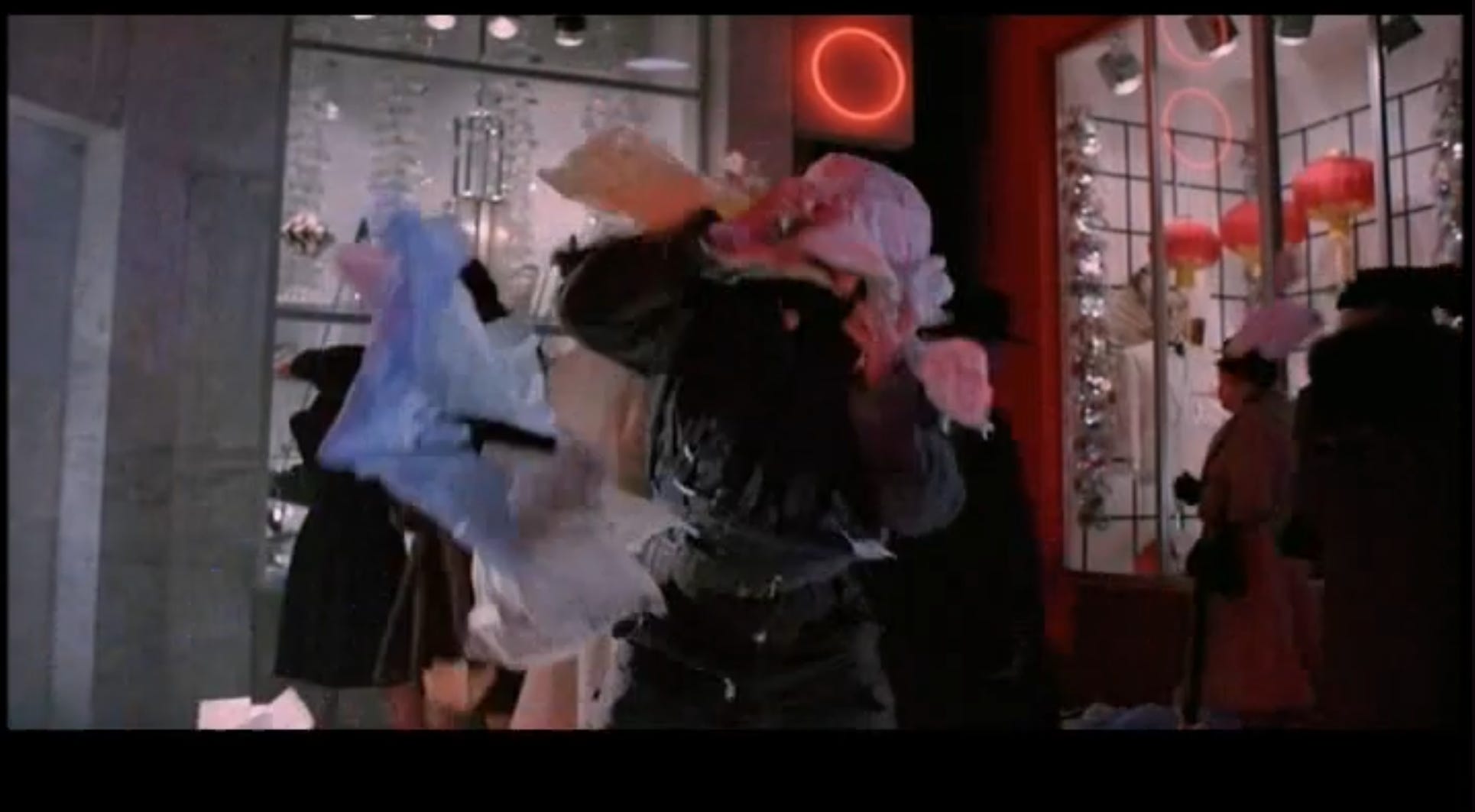
Harry Tuttle’s Demise (screengrab) Brazil 1985 Terry Gillam
I know that for some reason it is important, but I cannot for the life of me understand why anyone would want to spend time tracking old receipts for shit that happened months or years ago, when there are living breathing people right here in front of us and books to read, music to listen to. Woods to walk in, cats to pet and dogs to howl with.
Why would anyone want to spend time with stupid bits of paper with arcane symbols telling someone I happened to buy cherries, ginger ale, and get $50 cash back on May 2, 2025 at the superstore in Windermere so the people I was meeting with had a snack?
My books are still all on shelves, and my journals are all stacked in storage, my work products is sourced and I ensure I do no harm. These papers make sense to me and as a sociologist, what people document of their life is deeply compelling.
But my receipts and paperwork for things that the government cares about but for me feels like onerous ridiculous justification for complexity are overwhelming. And this has been exacerbated by the fact that the government has asked me after more than one filing to prove that my children are mine. But they won’t tell me why. And that creates a lot of nervousness for me as a single mum already under social scrutiny.
Paper is also an excellent way of keeping track of things that happened in the past that we would all be better off if we just let go. Like old report cards that you worked hard for and then the grade came and it wasn’t as high as you were hoping. Or the feedback was something like “Trisha is a bright girl, but her constant questions disturb other learners.” and you knew you did something wrong by someone’s standards, but since you didn’t get that book you have no idea what. Or who can tell you what you should do instead.
I am not talking collective history - that is something else entirely. More importantly, we lose our collective history when we are only interested in tracking things that relate to documenting performance, money, or extraction-based, based economic activities in ways that make them justifiable.
For example, my receipts for volunteering are not tracked - I don’t get a rebate on my taxes for the time I spent at the community league or on the school council.
I am talking specifically about the way paper is used as a mechanism of control and to enforce obedience, and when - like me - you grow up believing your very life is a mistake, then paper and records and all the institutional exchanges can become overwhelming.
Paper that proves I exist and that my kids are mine. That I have the right pedigree to live in the house I live in, to justify the job I do. My degrees stand-in as a proxy for capable.
This is the kind of paper I am talking about - the bureaucratic paper that exists to justify the paper that existed before. So I sit on some sorts of paper until it feels like it might sweep me away Brazil style like poor Harry Tuttle.
And then there is money!!
Everyone knows there is a right way to spend money and a wrong way to spend it. And if you spend it the wrong way, it means you don’t care about your future, or what will happen to you as you age. How irresponsible!
Also, please buy now because if you don’t the economy will collapse and no one will be able to afford to live and all the good things we have will vanish: food will never grow again, and everyone will blame you.
By the way, did you file your taxes so we can evaluate whether or not you’re spending your money correctly, according to arcane rules that feel unnecessarily confusing if this is supposed to be about government administration, you know?

Money has become this totally perverse proxy for value. We increasingly see that those with the most money do not seem to have values that ensure the wellbeing of others, even as we hand them more power.
And since the people being targeted by legislation and corporate policy changes (hello Deloitte getting rid of family-friendly policies and then bidding on contracts to create healthy workplaces?) are the same ones as me, I have a low grade anxiety that they will judge my spending and then evaluate me as less worthy of belonging.
And these fears have held me back for years because I don’t know how to manage the paper (and electronic records, so it’s constantly expanding) that comes along with 21st century life. I am afraid
I’ll “get caught” and someone will discover I am a ‘bad person’ and I will go to jail
My alcohol purchases will raise some eyebrows and the government will start an investigation into my ability to be a fit mother (my kids are well into their post-secondary)
Car rentals will suddenly become illegal and I will have to explain to them why I rented a car so many times in 2024 and 2025
My paper records will result in the government raiding my house for evidence (what kind? I don’t know … on who? I have no idea … did I do something wrong that they would raid my house? No but have you read the news)
My regular professional upgrading will be seen as unnecessary and I will lose my business license.
Now, I never said these were rational fears and that is actually the point. Many of the fear I have about paperwork and money are a result of watching news and movies and hearing all the time about how people are irresponsible both growing up, and now as an adult.
The undercurrent is:
Fiscal responsibility means job cuts, and service cuts
Fiscal prudence means no treats or extravagance - austerity for all
Fiscal wisdom means always finding ways to save, even while maintaining appearances
Good people tighten their belts and buckle down to make things work. That kind of life feels exhausting to me. What are we constantly tightening our belts for? Where is all this belt-tightening leading, since there don’t seem to be a lot of benefits for my neighbours either.
And so I don’t stop buying good olive oil from my local Italian grocer but I also feel guilty about wanting to enjoy my life right now. While I am living it. Rather than watching other people enjoy a good life that I might someday win the lottery to access.
And since I feel guilty, and ashamed of my lack of commitment, I ignore my receipts, and my mail and sometimes my bills (thank creator for automated payments - I am sure it is the only reason I still have a house) and then the paper grows. And the more the paper grows the more I ignore it. Until …. Harry Tuttle.
Getting it under control
I knew, and am still hyper-aware, that not being responsible each week (or month) meant that eventually there would be all the months at once to combat. And I knew that would be almost debilitating. So I asked a few people I knew if they would help me.
They said yes. Offered to “show me their system” and “walk me through records management”
But when I followed up to set a time? Crickets … I began to feel like even just asking for help to get my paperwork in order was a sign of weakness. A failure to be a ‘responsible adult’ and therefore deserving of whatever horrible fate I was on the receiving end of for failing to be good at bureaucratic paperwork.
Finally, after 15 months of letting this paperwork and receipt juggernaut pile up in nooks and crannies and ziploc baggies, I took a deep breath, squared my shoulders and began to look for supports. It just so happened a workshop was happening in early May and there was a session for entrepreneurs about building a stong business:
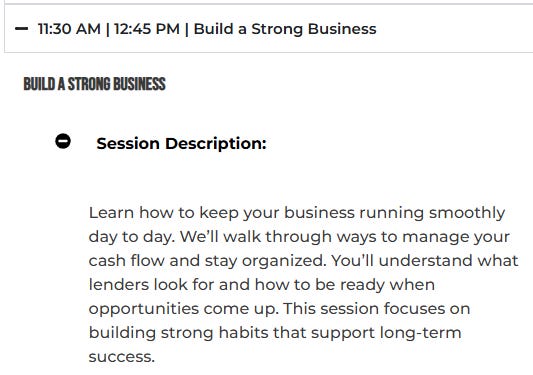
It felt like exactly the catalyst to get me reoriented in a good way. Strong habits? definitely needed those!
Manage cash flow? Yes please!
The promised moment of truth
Because the session was advertised as ‘learning how’ and ‘walk you through’ I expected a presenter who understood financial anxiety at least (I had hopes for financial or institutional trauma but didn’t expect it) and would introduce this with respect for early learners.
But when the session started there were a lot of acronyms, numbers, and references to organizations that I wasn’t super familiar with. Not surprising because, like I said, finances and administration is not my strong point. So I sat and listened for a few minutes and then asked
“Sorry, but I don’t understand the acronyms, or a lot of what you are referencing. And maybe that’s just me - I can leave if this is everyone else’s knowledge level?” I looked around, no one said anything.
I turned back, “can you dumb it down for me please?” They did, for that subject but swiftly returned to banker-speak and lost me (and much of the observable audience).
A few minutes later, one banker stood up to discuss business plans - not quite what I was expecting, but ok. He joked a bit as he opened and then said “What you put in your business plan doesn’t matter to me. It just has to be meaningful for you.”
Now, what kind of bullshit is that? We all know that there is an expectation of certain information being in business plans. That’s what we were there to learn so to make a “it doesn’t matter to me …” statement is completely disingenuous. These sorts of statements create institutional harm and distrust because the representative is being intentionally obscure.
Statements like this are what sets people up for failure. I sat in my chair in disbelief at the absolute lack of awareness from the presenters. And then I left. The session, the full conference. Why?
The weight of money mistakes
I was super nervous about money and finances because finances are unforgiving. I know of no confessional where our financial sins can be forgiven. If we take financial risks, there’s no search and rescue to get us off the cliff edge. And I am pretty sure I am not the only one who carries this weight - it’s why government pensions are often referred to as ‘golden handcuffs.’
So sure, businesses, send random bits of paper every year to an unforgiving bureaucracy. But I am behind the business and I am sending this without context or a chance to explain my decisions and what I learned. Why this person? Why that provider? Clearly they failed me since 6 months later I needed to start over. Or sure, maybe I failed myself or needed something different. The point is, there is always that feeling of judgement.
And for me, that is sometimes almost unbearable. What will these strangers think of me and the mistakes I’ve made over the last year, two years? Five? Because this is all documented and my history is exposed to anyone who looks.
It’s makes me feel vulnerable in ways that are hard to explain. But the death of Tuttle captures it - that my identity, all of who I am and what I’ve done over the years - all the good things even in the midst of mistakes - are lost under paper receipts of miscalculations.
And given the rise of credit card debt, and the success of financial insolvency experts, I’m guessing I’m not alone.
So how do I tackle this for me? Looking at the headlines about consumer debt and economic confidence after sitting in that stupid conference room filled with speakers who also knew very little about how finances work, I decided that come hell or high water, I was not giving in.
I embraced this newfound righteous anger at systems designed to fail people who asked questions or try something different. Or just want to do something that isn’t about maximizing profit.
I was not going to let some stupid set of bureaucratic rules set up to be intentionally difficult to navigate, reserving access to those who could afford it or had the time to learn it themselves, beat me. Instead, I looked at the times I had hauled myself up, figured out what it was I needed to do, and then with the help of prayer, meditation, wine on patios, walks in the river valley, yelling loudly at Creator, painting and task-avoidant housecleaning, I did it.
How I conquered my financial and paper overwhelm
Decide to do something different
Maybe it was feeling talked down to at the seminar, maybe it’s menopause, maybe it’s a combination but I realized that after 30 years of this somewhat debilitating fear, I was still alive and no one was coming to arrest me so I could tackle it.
Reach out to the right people
It occurred to me that people presenting at conferences who can’t speak to an audience without sounding like there’s a stick up their butt were the wrong people to speak to. Instead, I needed to learn to rely on the people around me who had proven themselves supportive
Rather than being afraid of not knowing things when I spoke to them, I decided to be honest - completely transparent.
Don’t get me wrong: this was still as uncomfortable as feck! It took me three days to finally accept that was what I needed to do.
I happen to have an accountant who I finally was able to open up to. I cried at her desk as I tried to explain how every time I opened up the spreadsheet the numbers just swam in front of my eyes
And I spent almost a decade doing hardcore data analysis so this made no sense to me. Why are these numbers so hard?
At this point, it is important to make sure you work with the right people for you. Not everyone who says they can help are actually able to help. Sometimes they just want to hit their monthly sales goals.
And sometimes their values are different than yours. This matters if what you are interested in is building a better future rather than just making money. Two years ago I still was worried people would think I was a loser if I told the whole truth. Part of that is because I was choosing the wrong people to ask for help because their values didn’t align with mine, I didn’t feel safe
What does this mean? Stop going to the hardware store for cold cuts. Ask people who want you to win and when you are around them you feel secure. Maybe people you know and trust aren’t able to help you with your paperwork but they might be able to help you find someone they trust.
This last part is important because for a few years, my nervous system was out of whack and often confused people who felt familiar with safety. But since I had just come from a highly toxic workplace, the people who felt familiar in professional settings were also toxic. I was not making good decisions so I needed to bring along someone who could.
Embrace fierce self-compassion
Being radically self-forgiving also means being fully accountable, because forgiveness means there are no excuses. To do this, I did the same thing for this as I have done over and over again:
What are the values I used when making decisions?
Examples of when those decisions worked (to counter when those decisions backfired)
Other challenges I felt overwhelmed by and overcame?
The strengths I called on to persevere?
I reoriented from the things I’ve done that needed to be corrected to the things I’ve done that were the right thing to do.
Then
I identified a role model to recall when I started to feel defeated
I created a mantra (well, picked one actually) and put that sticky on my desktop to remind me each time I started to give up
The mantra? I am stronger than my fear
And the role model story was a random tweet I read that popped into my head one day. I don’t even go look for it, just recalled the following details
I got sober at 49
Started my dream job at 53
Bought a house at 56
Or something like that. And I decided that if some random person on the internet could do this, why couldn’t I? I was reasonably smart and apparently not dead yet, so what did I have to lose?
Accept and Act
This part is where so many times I had failed. I made plans, even developed entire timelines, and then just sat there and looked at them for days. In order to act, I had to accept I am going to make mistakes because I have in the past, and I have also been successful, sometimes because of those mistakes but also remember I have done good things well and will do so again
> Then I set a deadline with my accountant.
> Cancelled everything in my calendar
> Bought myself a few easy to prepare meals
> Told my kids they were on their own for a couple days (and totally failed to achieve that, so …)
And sat down to tackle the paper.
I did arts and crafts, taping receipts to sheets of paper in chronological order while listening to ((put the song here that I’m thinking of. ))
I made excel spreadsheets and entered receipts in order
I downloaded receipts from company websites and searched my email
I cringed over and over again.
And each time I reminded myself that:
I made the decisions I made because I only had so much capacity and my kids came first. Always
I corrected mistakes as soon as possible
I chose impact over income each time (something I need to work on)
I followed my first principle consistently: first do no harm
Accepting and Acting are not a one-and-done thing either, you will need to accept and act over and over again. Particularly if, like me, you get distracted by your children.
I developed a routine to help me get recentered each time. This was like a moving meditation, a somatic intervention to short circuit the anxiety by cross-body puttering with my hands.
Make Decisions Grounded in Values
Then I reminded myself of when my approach worked. I made a win list of the things I did and continue to do well to remind me that we all have different gifts.
And then I listed my strengths: perseverance, fortitude, educated risk taker, pattern recognition.
Pattern recognition stood out. I looked at the list of things I needed to do and every single time again, I felt stupid. I felt like of all the things I can do, this ability to collect later continued to be my undoing.
And I finally accepted that it doesn’t matter how much time I spent sitting in front of my desk, or how many spreadsheets I made and how many times I taped paper to paper and submitted a pretty envelope to my accountant, this will always overwhelm me
In fact, even as I’ve been building better habits into this year
Better tracking
Proactive spreadsheets and paper taped to paper
A more structured work schedule
Clearer business KPIs (yes I have them now. Well, 3)
A business calendar of events and calls to action
I have realized each month this paper/financial admin still creates panic in me. Perhaps in part because I’m still emotionally maturing into looking at my finances and thinking about my decisions strategically rather than just “Do I need it? Can I afford it? Then I’ll get it”
And so in the end? I found all the receipts I could, stuck them in a folder with bank statements and credit card statements and sent them to my accountant.
I decided I wasn’t going to force myself to ensure something that literally makes me cry at my desk. How was this embracing my values?
Well, I was gentle with myself and recognized my weaknesses, we do not all have the same gifts for a reason. And I did as much as I could within the time frame I had made with my accountant, and I was honest with her and myself that I was not able to get it all done and that I needed her assistance.
I persevered even though I was crying sometimes. There was no one else in this world who could do some of the paperwork required (including my accountant) so I had to keep going. This led me to the final step that until recently, I hadn’t been fully grown enough to understand.
Systems are important, so build some
As I worked through the paper, taped receipts to bigger pieces of paper, stuck sticky note and paper clips, wrote names and topics on the back of receipts based on my journals where I track all my work, I realised I hadn’t avoided having a system, I just hadn’t really understood that I needed one.
In the past, I was an employee and there are all sorts of things that are just automatically taken care of then I suddenly had to worry about that in the past were handled in the black box labeled “Government Things” and since paper was a government thing, I never made the connection I needed to make my own government things black box all of a sudden.
And I am no good at black boxes, so again: accountant and another friend who is an organizational genius were my helpmates. But here there was also my yoga partners, and my Friday night patio companions who always had their own stories of failures. Systems are not just filing and records keeping, systems are support and safety.
Build some of these, you will need it. This goes beyond reaching out to people, as some of those are relationships grounded initially in transactional service provision. These people are important, but support in this case something different: this is the person who you trust when you are scared, and who you know has your best interests at heart.
Learning how to create systems that build both sorts of relationships well is important, because these relationships are a reflection of how you feel about and support yourself. If you don’t like and trust the people you do business with, you might want to check that out.
Final Thoughts
Even just thinking about the look on Janet’s face when she got the email makes me cringe a bit. Because I kept insisting I was totally capable. And you know what?, maybe I am after hours of dedication and sweating and crying.
Or I could just hire someone I trust and hand things over to them, use the tools they provide going forward so I am not in this place ever again. This removes the pain from my life while also giving me an opportunity to work with someone who can help me develop these skills.
For some reason I had this idea in my head I was supposed to be able to do this myself. The financial, business admin, paper stuff was an unavoidable prerequisite. But it’s not. We can decide to do things differently.
So that’s what I did.
Decide I want something different
Reach out for assistance (my kids, my accountant, prayer, random people) and check qualifications.
Embrace fierce self-compassion: be radically, delusionally self-forgiving and actively accountable for all my actions
Act on my strengths, Accept mistakes
Make decisions that align with your values.
Systems help maintain habits, so build some
And I realised that these steps are the same over and over again. There are tools that I use to help me get through each of these, like breathing or walking or making lists. Reminding myself I am a good person, being involved in my community even when I would rather sit on my sofa.
There are so many tools out there, but the tools have to be put to good use. These tools, well-applied, create meaning and purpose, they bring me joy. And maybe that was what I was missing: the understanding that work and joy are inseparable, not mutually exclusive.
Paper and financial stress had been an impediment to joy, to doing work that really mattered because I was so nervous about things I was ‘supposed to do’ to ‘be good’. Letting go of these chains around my neck that I never asked for has been amazing.
At some point, women stop trying to be good at everything.
For some of us, that happens at 49. For others, it happens when we’re drowning in receipts and shame. For most of us, it happens during menopause - that recalibration where our bodies are asking us to stop performing competence and start claiming power.
If you’re navigating this shift and want to explore what it means to lead differently - not better, just differently - I’m running a workshop on June 20 for women in their mid-to-late 40s discovering their fiercest selves. Registration link: https://www.eventbrite.ca/e/1989624500440?aff=oddtdtcreator
OR 📩 drop a note to ask questions.