

“The cruelty is the point”
“The system is working exactly as intended.”
These statements are becoming increasingly common but what do they actually mean. What system? And who’s cruelty?
These statements start something and leave questions unanswered. As though the observation of cruelty addresses the problem. Eventually people tire of reading statements that feel true but don’t have a framework or context in which they can be addressed.
In this essay, what it means when we say the system is working exactly as it’s designed will be discussed, and some steps about what you can do will be included at the end.
The system everyone is talking about is the one that creates the wound we diagnosed in the last essay: Colonial Dislocation Trauma.
Getting Started - Colonial Dislocation Trauma
Trauma in a people looks like culture.
~ Resmaa Menakem
The idea of Colonial Dislocation Trauma developed for me after years of reading about symptom-based diagnosis that seemed consistent across multiple presentations: people who have been deprived of feelings of safety and belonging look for that in myriad ways as they grow up and this is reflected in their interactions with the broader community.
Referencing the Indicative Trauma Impact Manual, which is described as a non-diagnostic, trauma-informed guide to emotions, thoughts, and behaviour, a number of the behaviours identified as toxic, like coercive control and grooming, are represented in our workplaces and our strategic policy choices.
Furthermore, just like in individuals, the outcomes - like creating rigid rules for safety, violent and sexually violent imagery, and dependence on substances for emotional regulation - are strong indicators of a system under duress.
What are you willing to do to keep your money and power?
Many people look for a way to feel safe and fitting in is one way of doing that. In our culture, fitting in is often determined by one’s wealth, financial success being a proxy for safety and belonging.
In the last essay, we named the wound of Colonial Dislocation Trauma (CDT)—the pain that comes from living in a system that severs our connection to family, culture, and self. But what happens to the people who benefit from and perpetuate that system? What is their diagnosis?
The result of money being the goal, as we are increasingly experiencing, is a culture that rewards greed, domination and control. Selfishness, and transactional business models are the norm because these provide short-term economic gains.
Unfortunately, people who succeed in this model generally display the less virtuous character traits because being greedy, controlling, and selfish is rewarded financially. Power becomes increasingly concentrated by creating ever-narrower criteria for belonging. Perverse incentives develop.
This brings us to the great inversion, the two paths of pain that define our culture.
People with Colonial Dislocation Trauma tend to internalize pain. This leads to toxic shame, self-loathing (”dirty Indian”), addiction as a form of pain relief, and the feeling of being broken.
People with Colonial Dislocation Psychosis (CDP) externalize their pain. They believe that they should have all the good things and that other creatures—because they don’t see those who are different as truly alive—should bear the burden.
Colonial Dislocation Psychosis is the psychosis of the colonizer, a mental state disconnected from reality of their actions and required to inflict and ignore mass suffering. It is a sickness of entitlement and I suggest it is a form of hierarchical collective derealization.
The Operating System
To thrive within a colonial system is to adopt its dysfunctional operating system. It is no coincidence that the traits required for success are often the same traits used to diagnose personality disorders that are considered anti-social:
A grandiose sense of self-importance
Sense of individual entitlement (as seen in doctrines like terra nullius)
A complete lack of empathy; unwillingness to consider the impact on others
Perpetual exploitation and violence against other people, animals, and nature
A constant need for admiration; money excuses any behaviour
A pattern of exploitative, manipulative behaviour, using lies to accumulate power regardless of the impact.
An inability to accept mistakes, even in the face of catastrophic consequences like climate change
Unwilling to share
Lack of accountability; might makes right
This psychosis is exemplified by a mindset that rewards executives with massive bonuses after causing immense harm, creating a feedback loop that bad behaviour is deserving of reward.
In an abusive relationship with a narcissist, the person in pain is punished for speaking up. Our system functions the same way.
A Modern Case Study: The Weaponization of Needs
This psychosis is not a historical artifact. It is alive and well in our boardrooms and coaching masterminds. I was in a session recently where I was talking about how money should be a tool for well-being, not the primary desired outcome. The coach responded that she loves money as much as she loves her children, all of us in the room. She loves it as much as she loves God.
We no longer work to feed ourselves or build our own homes; we must work for money in a way someone else deems acceptable to be able to meet our basic survival needs.
So many people live without a sense of confidence in the future. People are anxious the rules will change without notice and suddenly what’s in is out, and everything could be lost. Arendt carefully laid out how as people become increasingly isolated, money and rules become increasingly associated with safety and authoritarianism begins to set in.
Business under this psychosis is not about creating conditions for us all to prosper; it is about keeping people hovering at mere survival, because there is no profit in a fulfilled, sovereign population.
Colonialism and capitalism are required to weaponize our basic needs against us to ensure we continue to work at things we don’t like, not just food and shelter - but safety, esteem, and interpersonal relationships are all increasingly defined by socio-economic conditions rigged to incentivize anti-social behaviours.
The Social Symptoms of a Psychotic System
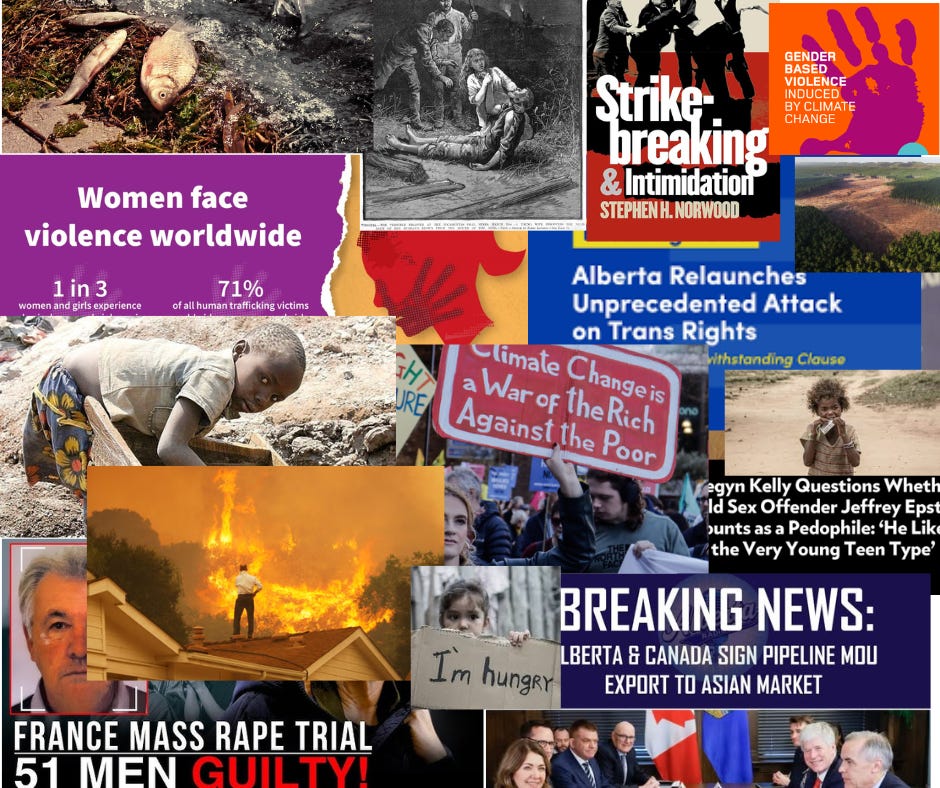
When a society is run by this dissociated, narcissistic mindset, the culture itself begins to exhibit the symptoms of the psychosis. This is the social breakdown we see accelerating around us:
The embrace of militarization and violence as the natural order
Rampant and increasing inequality
An accelerating degradation of the environment
The destruction of social bonds and contempt for community
The sexualization of children and the rejection of elders
The reduction of human beings to their most base motivations, with economic systems built on minimums of behaviour rather than aspirations for the collective good
Limiting the definition of who is human by legislating away rights
Rejecting children as autonomous being worthy of rights, nurturing, and respect
The functional goal of this psychosis seems to be to try and recreate what the universe provides freely as a way of proving dominance over nature. It is a profoundly immature and destructive worldview.
The Hollowness of the ‘Special’
In The Theory of the Leisure Class, Veblen (1899) makes clear his derision for conspicuous consumption as a terrible foundation for social organization. Cultures geared toward profit eventually do not produce useful products or healthy humans, as the pursuit of conspicuous leisure undermines social utility and perverts the human predisposition to useful production.
The ultimate expression of this psychosis is the belief that some people don’t have to work, that they are somehow special. This entitlement to a life of conspicuous leisure, as Veblen called it, can only be sustained through the forced labour *and* forced consumption of others. (Others, in this case, is us. The 99% of people who don’t own their own islands and personal jets.)
Essentially, the market will force workers to make things they don’t need, and then force us to buy what they’re selling us, even if we would much prefer something different, so we can access our basic needs like food and shelter.
As resources become increasingly scarce, these mechanisms of control will become increasingly rigid, which means our children will inherit a new form of slavery, where the necessaries of life are privatized for maximum extraction.
Sound familiar?
This stands in stark contrast to healthy humans. Healthy people like to work. They like to contribute to something bigger than themselves, being a part of the labour market is one of the number one indicators of mental health.
In our current social system built on ideas of extraction, however, social colonial dislocation results in work that controlled by people who want to limit access to resources, is not pragmatic or even really worthwhile, often results in moral injury, and is exploitative of the worker and the natural environment.
In contrast, conspicuous consumption is not only suspicious in Indigenous communities, but generosity and giving freely is seen as an act of leadership. It is why many traditional Indigenous ceremonies like the Potlatch were banned by colonial governments: these ceremonies were cultural expressions of shared responsibility and shared benefit in action.
For those with CDP, work is for others, and those others only have value as long as they are producing for the economy, regardless of the impact on them or nature.
This is the hollowness of a dislocated system: your life becomes so empty of personal meaning and authenticity, that the only goal left is to not have to participate in it at all, to be able to buy your way out of being part of the world.
Conclusion: The Next Step is Your Choice
The system that is operating as intended is one that prioritizes profit for the few over the wellbeing of everything and everyone else. This is an anti-social operating system run by people who believe their cultural entitlement is more important than our shared humanity.
This system, and the people who benefit from it, externalizes its pain, rewards cruelty, and has the desire to fully consolidate power and resources in an increasingly small minority. The result is trapping us all in a market where our survival is conditional on our obedience to arbitrary, artificial rules.
Colonial Dislocation Psychosis is the answer to the question, “How can they act this way?” The people making decisions that seem irrational to the rest of us act this way because they are living in a dissociated state. The dissociation exists in two ways
A belief that what is written on paper is more real than what is happening in the physical world they are standing on, a collective derealization
A practice of externalizing the impacts of their decisions onto others with less power by framing colonial, or leisure class, wants as needs.
The majority of people experience the psychosis as living in a system that
prioritizes profit over people,
values domination over connection, and
decides the consequences of the wealthy and powerful on the world are not sufficient to change their actions
A more sustainable future that does not reward anti-social behaviours starts with you. By choosing to reject a divisive operating system in our own lives we begin to act in ways that challenge transactional economies, creating the reciprocal and restorative relationships so many of us are seeking instead.
The most powerful antidote to a system that denies our agency is to begin exercising it. We can choose to value:
contribution over consumption,
community over extraction, and
empathy over entitlement.
Many people already make these choices everyday. The proof is in the collective action taken in our daily lives:
People who volunteer, donate to foodbanks, or buy from school bakesales.
After disasters, many people open their doors to displaced people
Volunteers clearing up after community events, sending letters to and phoning politicians, people driving others to vote
We are not powerless, but the path forward requires us to see the system for what it is—and then choose to build something different. How? Decide which values matter to you and then take action, and find someone to do these small steps with, have fun along the way. If trauma in a people looks like culture, then healing in a people looks like community in action.
This is Part 3 in a series introducing the framework of Colonial Dislocation Trauma. In the last essay, we diagnosed the cultural wound. Today, we diagnose the psychosis of the system that created it. In the next essay we will introduce some common experiences of people living in a sick system, and ways to begin to create safety for yourself.
Why does naming this matter?
For too long, many of us have operated on the assumption that the people making destructive decisions simply needed more information.
But the system is not broken; it is a successful machine designed to protect the entitlements of a few. We cannot heal it by providing more data to those who benefit from the sickness.
We can only heal it by building something new.
This is where the real work begins. The antidote to a system of dislocation is community. The antidote to a life of meaningless work is to find the work that reconnects us.
If this conversation is one you want to be a part of, I invite you to subscribe to my newsletter.
"Decide which values matter to you and then take action, and find someone to do these small steps with, have fun along the way." Honestly, I think this has been one of my biggest takeaways over the years, after working in different sectors. I used to believe change had to come through grand sweeps of action. Yes, there's a place for that, but more often than not, smaller steps in a community or circle can have an impact beyond what we imagine. Thank you for sharing your wisdom!