

On Saturday I attended a community emergency preparedness workshop hosted by my community league. I’ve spent over a decade working in emergency management in some capacity but I hadn’t attended a community preparedness workshop for years and figured I needed a refresh.
I went with one question: How will our city support women and children as we experience increased creeping disasters like heat waves, drought, and prolonged wildfire smoke since all of these lead to increased male violence, particularly domestic violence and child abuse?
There were 10 of us at the event. Seven women, all community residents; three men: the presenter, the organizer (also a resident), and the city’s neighbourhood resource coordinator. A great way to get to know our neighbours, with a notable absence of men concerned about collective safety.
Overall, the workshop provided an overview of how disasters have been managed in the past in Alberta, what the presenter had learned, and some anecdotes that exemplified how emergencies often result in creative solutions.
Like Jabbar Gibson, a 20-year old man from New Orleans, who, after Hurricane Katrina, “liberated” a bus and headed out with 8 people to drive the 300 miles to the Houston Astrodome. They rescued stranded strangers along the way and riders pooled their money to buy gas and diapers.
So did the material in this class teach me?
Need for clear communication in the community.
But the workshop offered no follow-up on what that meant for the community or how to do it. There was also no information provided on emergency communications other than the alerting services or how residents could be in contact with officials.
There was also no information about best practices for communities who would like to be more proactive in developing relationships with the city to facilitate communication in emergencies.
The community needs a resource list.
Sure, we played “bingo” with the attendees to learn the room had things like generators and landlines. But there was no suggestion on how to operationalise this, or actually build a community resource list or what to do with it when you had it.
Later in the day I made a patently ridiculous suggestion that there should be no resource list at the main hub and the presenter accepted that as a reasonable statement.
People see our neighbourhood in different ways.
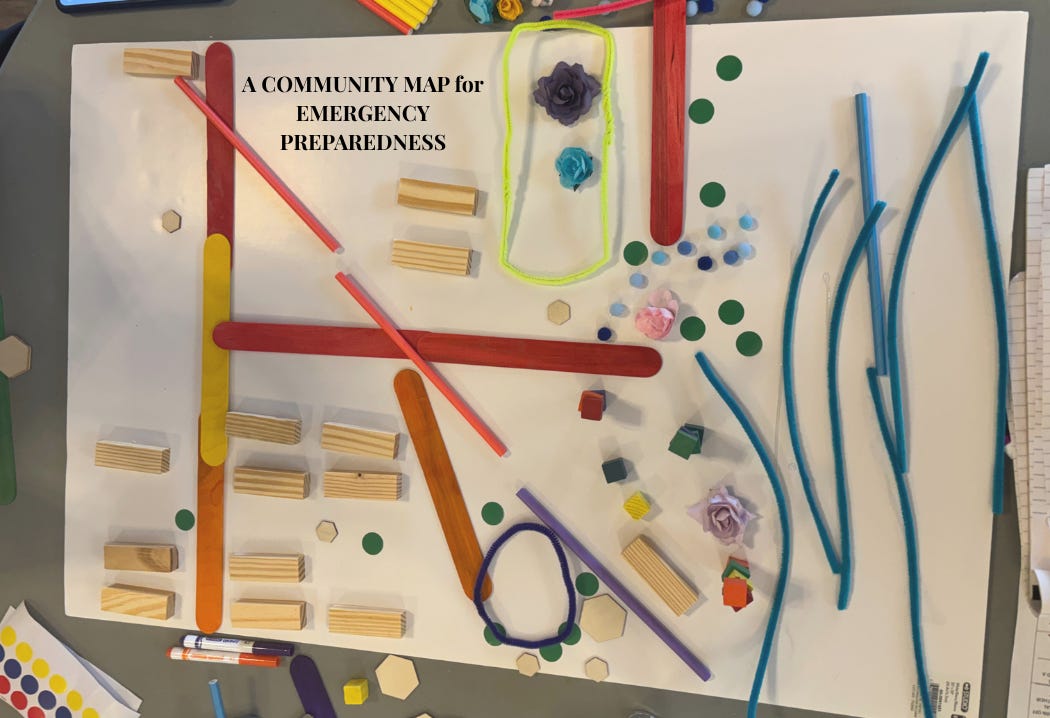
We made a representation of our neighbourhood on posterboard and it showed how everyone experiences their community differently. I don’t have a car, so my boundaries were informed by side streets and bus stops. For others it was based on major arteries, or official mapped boundaries. Or what it ‘felt’ like, where they accessed green space.
Doing this, coupled with the feel good stories was encouraging; we perked up at our imagined heroism. (Or maybe that was just me). At the end of the event, after a 20 minute game where we imagined there had been a tornado, the different table groups shared their experiences. Overall it was a mostly pleasant day.
Key Takeaway for Community Preparedness.
I had noticed throughout the day there was a difference in how the groups answered the questions. The men, when they responded during the exercises often identified the issue as “Someone should have told me _____.” The women started their responses with “I needed to ____.”
I thought this was a strange difference, but since there was only a small number of people, I didn’t think anything of it. Until the end, when the presenter gave us the grand finale, the main piece of advice for community preparedness.
The answer? Block Parties.
I felt my jaw drop. I raised my hand and said “At the start of this event I raised concerns about the increase in male violence against women and children during emergencies and disasters. I don’t see how this addresses those concerns?”
The presenter had no answer.
I pressed him “We have known about the increase in domestic violence and child abuse since at least Mt. St. Helen’s in 1980 and we know women and children bear the brunt of climate change, so how is this addressed in the emergency planning process?”
The presenter hummed and hawed and eventually admitted that he had no answer.
Not even for the place where he was responsible for the safety of the community when there was an emergency.
Even worse? There were no suggestions on what should be included at these block parties, or how they create more emergency preparedness.
No information on who will organize these or what to do after the block party. And no financial assistance from the City. Although they are happy to provide traffic cones for our safety.
The list of concerns I left with feels overwhelming:
If men are in charge of emergency management (and largely they are), why is the most important part of community preparedness expected to be done for free?
Women are consistently left out of the decision-making process, and the impacts of disasters and emergencies on women and children are not a factor in any planning. (I looked at the Alberta Emergency Plan, and there is no mention of gendered violence or increased risks to women.
Why are women expected to do the relationship building that emergency management depends on, but not provided any supports during evacuations that ensure they are kept safe?
Under International Humanitarian Law (IHL) there is protection for:
Women Prisoners of War
Protection against Sexual Violence
Protection for Mothers (Pregnant Mothers, Nursing Mothers and Mothers of Young Children).
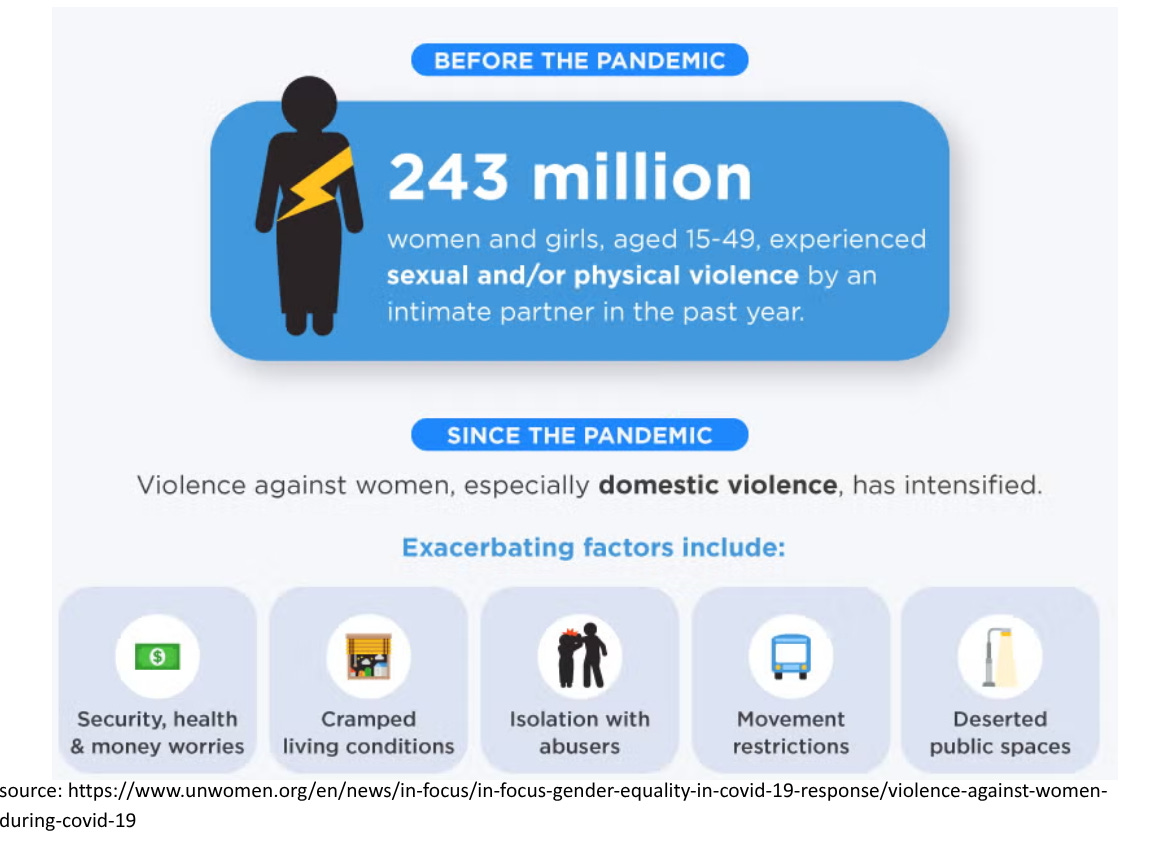
But during disasters, NONE of these requirements are considered in evacuations or quarantines and confinements. During COVID, domestic violence was considered a “Shadow Pandemic”
What does this mean for our communities?
I went to the event because disasters and creeping emergencies increase male violence, particularly domestic violence and child abuse. Crimes we already see increasing as the economy stalls. There is a lot of research on the impact of climate change on the safety of women and children.
But do you know what was not mentioned once in this entire 4 hour event?
Male violence and the increase in domestic violence and child abuse during disasters.
Instead we were told to organize block parties.
I have worked in emergency management since the 2013 Southern Alberta Floods and the ongoing failure of emergency management organizations to address the unequal impacts on women and children speaks volumes about what we can expect as disasters become more common.
There will be an increase in:
Women being isolated from the larger community
Increased violence against women, both in quantity and extremity
Restrictions on women’s economic freedom
Increased child and elder abuse
Decreased access to social supports and services
Increased domestic responsibilities on women and children
Decreasing housing stability
Increasing food and water insecurity
How do I know? This image shows the trends in reported intimate partner violence during hot months, no emergencies noted, increasing as temperatures increase. The research on this as a causal link is overwhelming.
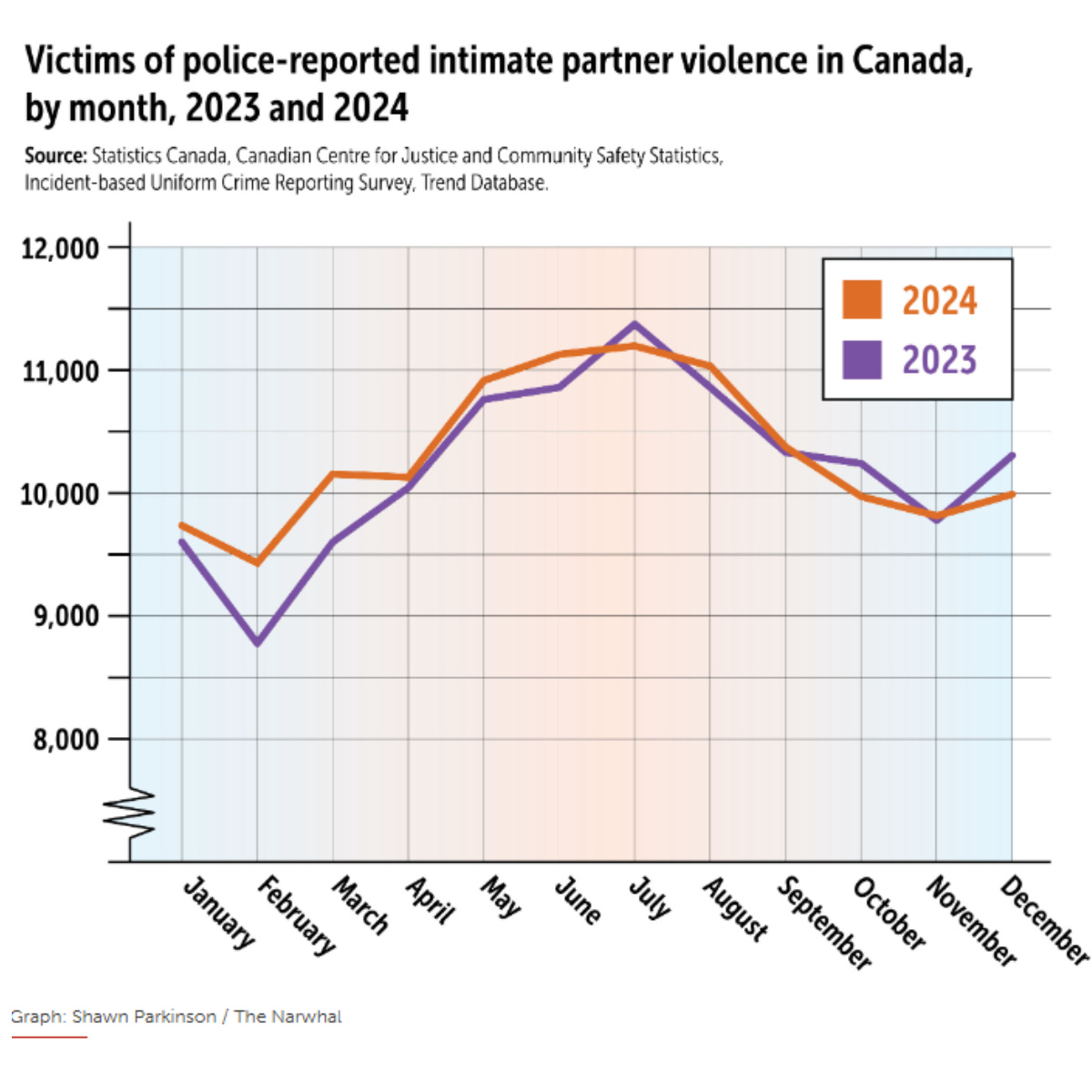
The research on the need to address the increase in male violence toward women and children during and after disasters has been available for decades. Even without additional stressors, as the heat magnifier graph above shows, just a temperature change is enough to increase male violence against women.
Additionally, in multiple after action reviews worldwide there are recommendations to provide safety for women and children from male violence. And year after year no action is taken. Instead, All-Hazard Incident Management Teams are built. Or fancy radios are bought. But no action is taken to provide safe accommodations for women and children.
In fact, after the 2013 Southern Alberta Floods, the names of women who had been evacuated from a domestic violence shelter and were in hiding from their abusers were publicly posted. And nothing has changed since. (There is an excellent article that goes into more depth here)
I am also familiar with this failure personally, and not speaking from a distance. I was on the receiving end of male violence in the workplace responsible for addressing men’s violence against women after disasters. In fact, I was the lead for GBA+ (gender-based analysis) implementation. And so when I complained about what happened to me, I thought the system I had been teaching would support me.
But I was wrong.
Even as an employee - someone who’s name they actually know - they still chose to protect the men who perpetrated a violent act. If they won’t protect female employees, people they know and rely on, why would they protect women they have never met?
The Preparedness We Need to Build for Ourselves
First:
It is really hard to accept that the system that we have worked in and supported for so long has so little care for us. So take the time you need to accept this is being left on you by the very people who tell you they have the answer.
Perhaps there are skeptics: “how could she possibly know there is no positive change coming soon?”
I left government to do this for a reason, and it’s not because government was doing cool, innovative things that I could not wait to be a part of. That’s how I know we need to do this for ourselves.
The good thing? Emergency preparedness is something women are generally fairly good at. It’s the men in charge who are incompetent.
What men are good at is heroic measures that require pulling out all sorts of fancy equipment and not sleeping more than 3 hours in every 24, while yelling at people to “follow the chain of command” and in this fever, they believe they can do anything. This hangover lasts, based on my observation, for at least 10 months before they start to revert to their baseline, and then crash a wee bit.
So long-term planning and preparedness that fully integrates the lessons observed after disasters doesn’t happen unless the answer is coordinating important roundtables to discuss the hard work they have done, or trying out new toys. I know because when I needed major documents signed, I organized meetings at “unique locations equipped with a range of opportunities to see and test response equipment”. Never left without the decision I wanted.
Second:
We need each other to make this work.
More than that, we need to be honest that for women to get this done efficiently, we need to leave men’s block party suggestions at the door. When women acquiesce our safety to men, our safety is not considered.
There is a recently developed Gender Emergency Management Framework that provides a great visual for developing a plan that creates safety for women and children. It looks an awful lot like what a healthy community looks like.
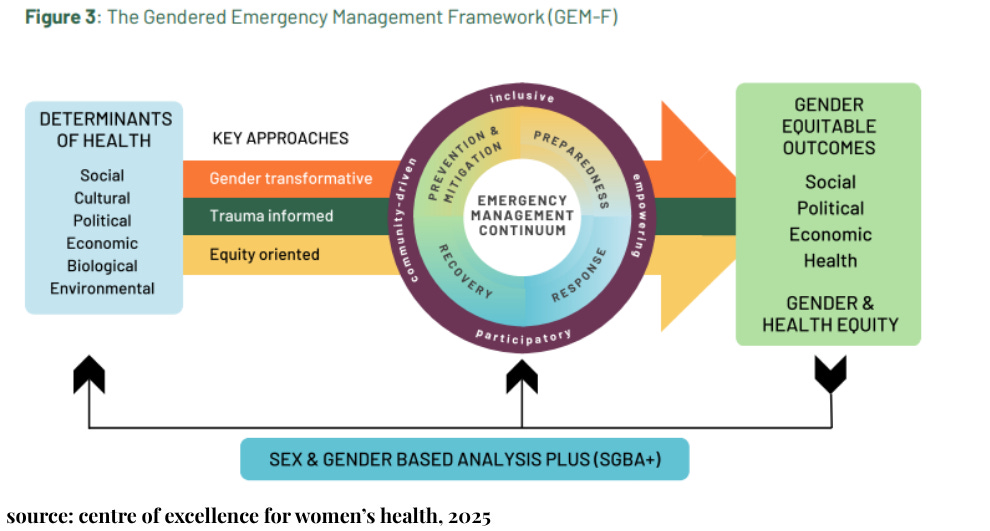
The Social Determinants of Health (the blue column on the left) entered the conversation in the 1970s-ish, and are an effective way of identifying injustice, and still women are not part of the Emergency Management Continuum Process.
I am not saying block parties are a bad idea but they are insufficient so here is where I think we start:
Support women-owned businesses, particularly women working in industries and occupations that are male-dominated
Join a gardening or walking group in your local community
Attend community events at small businesses or public spaces
Donate to the food bank
Learn a craft or skill - woodworking, knitting, cooking on a fire, archery
Pay attention to local politics and attend council meetings. Meet with others afterwards to share concerns or develop plans for things that are not being addressed to be presented to council
Be active advocates for moving to renewable energy quickly, reducing energy volatility
VOTE for people who protect women and children, not profits
Plant garden vegetables - even if it’s a tomato plant or basil on the window - to feel the connection with growing something
Men have moved decisions in a direction that they want for years by leaving the organizing and implementation to women. This community preparedness workshop made this abundantly clear to me. There were so many opportunities for the presenter to acknowledge the disproportionate impacts, especially since he’s been in the field for over a decade. But they weren’t raised at all.
“Plan a Block Party” is not a preparedness strategy. But it certainly seems like “Women taking care of ish” is men’s preparedness strategy. We cannot trust this in their hands if we want a future where the wellbeing of women and children is part of the plan, not the plan itself.
What Does Any of This Have to Do with Indigenous Systems Thinking?
Everything.
The emergency management failures described above are not accidents. They are the predictable result of a worldview that extracts from community rather than enriching it. That measures success in equipment purchased and roundtables held rather than in the safety and wellbeing of the most vulnerable.
Indigenous Systems Thinking starts from a completely different assumption:
Everyone is wanted here. Everyone’s safety matters. The community’s job is to ensure everyone’s needs are met - before, during, and after disaster.
This is not idealism. It is the oldest model of sustainable community resilience we have. And it is exactly what emergency management is failing to provide.
If you want to understand the framework behind community resilience that actually works - for women, for children, for all our relations - I am running a 5-week Indigenous Systems Thinking crash course starting June 23.
No prior knowledge necessary. Just curiosity and a willingness to consider there might be a better way.
📩 Email trisha@trishamcormond.com to join the waitlist or ask questions.
Because block parties aren’t a preparedness strategy, community grounded in Indigenous Systems Thinking is.